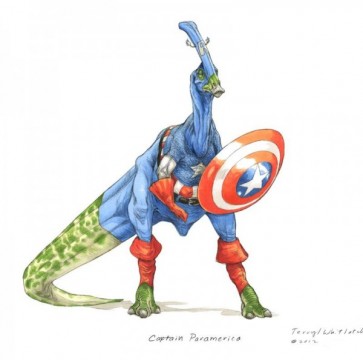
Okay, Terryl Whitlatch: We’ll forgive you now for Jar Jar Binks . Take a gander at the neat-o sketches by the illustrator and Lucasfilm creature creator (who’s responsible for concocting the most annoying character known to the Star Wars universe and maybe mankind) in which members of Marvel’s The Avengers are re-envisioned… as dinosaurs. Why not? Hulkasaurus! Captain Paramerica (Aka Parasaurolophus Rogers)! Kind of brilliant, if random. And yes, I’d pay to see a dino version of The Avengers in a heartbeat. Get more dino-Avengers here . [ The Mary Sue via Gamma Squad ]
Happy Hitler’s birthday! Wait…no. Sorry. We mean, happy Unofficial International Day of Cannabis Consumption! Yes, today is 4/20 , that magical day when stoners of all stripes toke up in celebration of the wacky weed. Skin Central doesn’t see how that’s different from stoners toking up every other day of the year, but hey, who are we to be a buzzkill? Especially when the stoners in question are sexy, female and naked, a phenomenon so popular, there’s an entire website devoted to just that. Hot potheads exposing their kind chest buds while sucking on a long glass object with more than a passing resemblance to a schlong…put that in your pipe and smoke it. Get the munchies with Mr. Skin’s HAROLD AND KUMAR Movies: Every Nude Scene and CHEECH & CHONG Movies: Best Nude Scenes playlists right here at MrSkin.com!
Yikes : “Meenakshi Thapar, 26, who had appeared in the Indian horror film 404 last year, met two aspiring actors who allegedly later killed her on the set of her latest film, Heroine . According to police, her ‘fellow actors’ warned her mother they would force her daughter to take part in pornography films if their demands were not met. Her mother paid 60,000 Rupees [$1,152] into her daughter’s account for her kidnappers to withdraw, but she was allegedly killed soon after. She was strangled to death, beheaded, and her body was dumped at two different sites as her killers made their way back to Mumbai. Her torso was dumped in a water tank and her head thrown out of the bus window in a bag on the road to Mumbai.” [ Telegraph via THR ]
LAPD detective Brett Goodkin helped bring down the infamous “Bling Ring” of young thieves who lifted jewels and other valuables from the homes of the Hollywood elite (and Paris Hilton). That made him an ideal consultant for Sofia Coppola’s dramatization of the affair, currently underway with Emma Watson (pictured on set) in the leading role. Well, sort of ideal, except for one huge conflict of interest. From the LAT : Police officers have served as paid consultants on Hollywood projects since the dawn of the crime genre. But experts said Goodkin’s actions are highly unusual because the case is still in court, where his financial interest in the film is certain to become an issue raised by the defense. Goodkin never notified prosecutors of his work on the movie, though his testimony is likely to be central at the trial of three remaining defendants. Informed by The Times of Goodkin’s role, a spokeswoman for the Los Angeles County district attorney’s office expressed shock: “We did not know, and now that we do we have to evaluate what impact this may have.” Legal experts said Goodkin’s consulting work could significantly complicate the prosecution’s case. “This looks very unsavory, and it could make a big difference in attacking the credibility of the investigator,” said Thomas Mesereau, a criminal defense attorney who defended Michael Jackson in his 2005 child molestation trial. “Clearly, it presents a conflict of interest if someone’s investigation becomes oriented toward creating a story or entertainment. It’s certainly going to taint the investigation’s motives and make them look unprofessional.” Goodkin reportedly is distancing himself from the project henceforth, while prosecutors may yet be legally compelled to bargain with the remaining defendants awaiting trial. Tough break. But come on! They broke into Paris Hilton ‘s house! Those kids should have pleaded no contest months ago and been sentenced to 30 days of desperately needed taste rehab. Let’s make a deal, already. [ LAT ] Follow S.T. VanAirsdale on Twitter . Follow Movieline on Twitter .
Before IMAX became a way to boost action sequences — Tom Cruise dangling from the tallest building in the world, the Joker’s gang rappelling down from a Gotham City high-rise to rob a bank — the outsized format was primarily the domain of nature films like To the Arctic 3D , which aim to dazzle with large-scale shots of mountains and dolphins and Australia and other impressive-looking things. Forty minutes long and narrated by Meryl Streep , To the Arctic uses spoonfuls of cuteness — featuring walruses and caribou, though polar bears are its primary animal stars — to make its fairly grim environmental message go down a little easier. Directed by Greg MacGillivray, an old hand at IMAX docs, To the Arctic tries to balance out its underlying sense of global warming alarm with spectacular imagery and footage of the far north ecosystem at work. Of course, even when it comes to the most roly poly of polar bear cubs, life at the top of the world isn’t easy, and while the film discreetly leaves the majority of the process of hunting and gobbling down seals off screen, it does include some potentially troubling sequences involving the food sources the male bears turn to when desperate. Polar bears aren’t easy to film — a segment about how would-be cinematographers camouflage remote-controlled cameras in order to get closer shots of the animals shows one bear breaking a device like an enraged celebrity attacking a paparazzo. So when the filmmakers find a family of bears and are able to stick with them for several days, they end up catching a chase across the ice. It’s a mother polar bear and her two cubs who are the heart of To the Arctic , the trio traveling across the diminishing sea ice as the mother searches for food for her offspring in the lean summer months when hunting is more difficult. Survival isn’t a certainty — earlier footage shows a mother swimming for nine days and hundreds of miles in search of meat, her cub not surviving the journey. But in the case of these bears, their most dangerous enemy turns out to be males of their own species, who will eat cubs when they can’t find seals to nosh on. The mother anxiously herds her children across the ice floes, always on the lookout for other bears, though despite her caution one finds them and tries to track them down. (Parents with children and sensitive stoners planning on seeing the film can rest assured there are no scenes of violent polar bear cannibalism.) To the Arctic flutters from place to place, peering in at some Inuit hunters and researchers who dive beneath the ice, then traveling with a pair of scientists tracking caribou migrations before pausing to watch walruses loll in the sun and then jumping to a ship departing from Svalbard. The only thematic ties beyond a shared region are the environmental threats being posed by global warming, which is making it harder to polar bears and walruses to hunt and is wreaking havoc on the caribou migration patterns. The film is marked by a few jarring stylistic touches, like a score that wavers between dramatic instrumentals and Paul McCartney songs (“Mr. Bellamy,” “I’m Carrying” and “Little Willow”) and opening credits that explode into shards of ice that fly at you — narrated by Meryl Streep BOOM! Streep offers her voiceover with nary a sly twinkle, even when delivering lines about the “frisky dance of the northern lights” or urging that “we can help keep the Arctic white.” But it’s the visuals you’re here to see, and they look great on the massive screen in three dimensions, especially in helicopter shots that whirl past waterfalls cascading off of glaciers or travel over the fantastic tundra like there’s an army of orcs to be discovered just over the next bluff. 3-D and IMAX may no longer be new, but in moments like those, they can still summon a sense of awe. Follow Alison Willmore on Twitter . Follow Movieline on Twitter .
It’s only appropriate that for his 50th anniversary James Bond throw a pool party for all his friends. That’s what’s going on in this poster from a Bond marathon taking place this week in San Francisco. Also, we have video of Anthony Hopkins doing his Hitchcock impersonation and a look at the alien from “Battleship,” Broadcasting platform : YouTube Source : MTV Movies Blog Discovery Date : 19/04/2012 19:38 Number of articles : 2
Nicholas Sparks. The name alone conjures up images of a romantic connection leaping between two people like an electric current, of fireworks illuminating the sky behind a couple canoodling at the side of a silvery lake somewhere and swearing they’ll never be parted — except that she’s dying of terminal amnesia and he has to leave tomorrow for an 50-year deployment in the Middle East, oh no! Love means never having to say “I wasn’t crying, my allergies just got really bad all of a sudden!” in Sparks’s world, and that remains true for the latest adaptation of his work, The Lucky One , directed by Shine ‘s Scott Hicks and starring Zac Efron and Taylor Schilling in a story as gauzily soft and disposable as the tissues the susceptible might need to pack. Efron plays Logan, a Marine home after three tours of duty and struggling through a sense of displacement and jolts of PTSD. One morning after a raid while he was still in Iraq, he spotted a photo on the ground and went to pick it up. The act took him out of the path of a bomb that exploded a few seconds later, one that would have killed him if he’d stayed put. After surviving a few more brushes with death, he came to believe that the picture, of a blond woman, was his lucky charm, and he vowed to find her in order to thank her. He does this by packing up a duffel and heading out on foot with his dog, walking from Colorado to Louisiana in search of the (fictional) small town of Hamden, Louisiana, located in that region of the South — I’m sure you know it — in which it’s perpetually golden late afternoon. He matched a lighthouse there to one in the background of the photo, and after a little asking around, he finds his way to a dog kennel owned by the cheery Ellie (Blythe Danner) and her granddaughter Beth (Taylor Schilling), a skittish single mom with a bullying ex-husband — and, of course, the “guardian angel” from the photo. The Lucky One is filled with talk of destiny, much of it done by Efron in the opening and closing voiceover, but like any movie romance, it needs a complication to potentially keep its fated leads apart. In this case, it’s the seemingly easily surmountable (it’s no terminal amnesia) quirk that Logan “can’t find the right words” to tell Beth why he’s really there, and so instead takes a job at the kennel and begins winning her over with his kindness and rippling biceps. What will Beth do when she finds out? She’ll get mad, but I’m honestly not sure why — maybe if he’d been carrying around a nude photo of her, or been keeping locks of her hair and smelling them compulsively, it’d be something to get creeped out about, but his explanation is pretty legitimately sappy. Efron and Schilling play a Disneyland version of a traumatized veteran and an emotionally abused spouse, their emotional wounds salved by their time together during a courtship that consists of a lot of mutual ogling through windows and fixing of boats (not a metaphor). Logan also bonds with Beth’s son Ben (Riley Thomas Stewart), a boy whose love of chess and playing the violin doesn’t sit well with his demanding, tough-guy father Keith (Jay R. Ferguson). Efron isn’t plausible as a battle-scarred soldier, but even without the fake tattoos he’s no longer built like a tween heartthrob. While Schilling — in cutoffs or floral dresses, her hair in a messy ponytail — is treated with chaste deference by the camera (she first appears walking out of the light like a near-death vision), the film has no problems lovingly objectifying the newly buff physique of its male lead. The Lucky One aspires to but never reaches the grandly melodramatic heights of the über-Sparks adaptation The Notebook , though a reconciliation embrace in an outdoor shower of some sort seems deliberately staged to evoke the earlier feature. The film can’t with any conviction portray this as a great love, even on simplified and schmaltzified scale (“You should be kissed every day, every hour, every minute,” Logan tells Beth) — Efron and Schilling simply look like two pretty people who are bound to get together because they both have the big blue eyes of a porcelain doll. Their problems are made to appear so mild, and the setting in which they live so idyllic that The Lucky One becomes numbingly pleasant, a cinematic anesthetic. It may not be The Notebook , but The Lucky One does unintentionally evoke another cable-TV standard in its story of a zen-like wanderer, trying to leave behind a violent past, who comes to a small town, rents a run-down place to live and falls in love with a girl whose jealous ex has a lot of local power. It’s Road House without, well, the road house. And instead of doing tai chi out by the water, Efron’s character prefers, sensibly but less interestingly, to just walk. Follow Alison Willmore on Twitter . Follow Movieline on Twitter .
Clark’s influence endures today with such stars as Ryan Seacrest. By Gil Kaufman Dick Clark on the set of “American Bandstand” Photo: Getty Images Without Dick Clark, there would be no Ryan Seacrest. Hell, without “America’s Oldest Teenager” there would be no “TRL,” and maybe no MTV. Clark, who died at age 82 on Wednesday (April 18) after suffering a heart attack, never sang a note or released an album. He wasn’t the inventor of a dance craze or a label boss or even a particularly hip guy. What he was, though, was a visionary. And as much as any hotshot who played a guitar, figured out how to mix two turntables and a microphone, wiggled his hips or invented the next big sound in music, Clark was instrumental in making pop music pop. Photos: The life and career of Dick Clark He brought rock and roll into America’s living rooms in the 1950s, just as the sound of young America was upsetting parents, confounding the staid radio programmers of the day and encouraging teenagers to shake, rattle and roll. Though he dressed like a martini-swilling ad executive and was adamant about keeping a strict tie-and-jacket dress code on his long-running signature show, “American Bandstand,” Clark lived by one simple credo when it came to judging music: “It’s got a good beat and you can dance to it.” Most importantly, when he took over “Bandstand” and went national in 1957, Clark put teenagers on TV at a time when the most popular shows were aimed at their parents’ generation, including such popular series as “Gunsmoke,” “I Love Lucy,” “The Danny Thomas Show” and “General Electric Theater.” He let them see themselves on TV, which seems like no big deal to today’s YouTube-ified teens, but was a revelation for the first generation to grow up in front of the tube. An MTV VP recalls his first job in television, working for the late Dick Clark. With one of the longest runs in TV history (1957-1989), “Bandstand” became a crucial stop on any major artist’s promotional rounds. And with good reason: The show drew an audience of more than 20 million at its peak, half of whom were reportedly adults. Among the acts that lip-synced their hits on the program and got their first major exposure over the years: Chuck Berry, Sam Cooke, James Brown, Simon & Garfunkel, Johnny Cash, Aretha Franklin, Jackie Wilson, Marvin Gaye, the Jackson 5, Chuck Berry, the Doors, Pink Floyd, Prince, Kurtis Blow, Cher, Devo, LL Cool J, INXS, Bon Jovi, Run-DMC, Madonna and the Talking Heads. Clark would chat the artists up and, even as the years went on and the styles changed from the buttoned-down 1950s to the freewheeling 1960s, disco-dancing 1970s and new-wave 1980s and the show’s influence waned, Clark’s enthusiasm for the hits of the day was unwavering. The times changed, but Clark appeared ageless, his full head of hair and boyish smile as much a staple of the show as the enthusiastic dancing of its real stars: the audience. Though controversy would later rise over Clark’s claims that he integrated the show in 1957 (as well as a nearly career-derailing brush with the payola scandals of the 1950s), what is indisputable is that Clark offered a forum for both black and white artists at a time when there were few. The sight of black and white kids dancing together also inspired one of TV’s other enduring music programs, “Soul Train,” whose recently deceased leading light, Don Cornelius , was sometimes referred to as the “black Dick Clark.” Ryan Seacrest, Snoop Dogg and more celebs mourn Dick Clark. Clark didn’t just spin the hits, though. He created the template for the modern multitasking media mogul, a mantle picked up by his heir apparent, the unflappable Ryan Seacrest. He helped produce or executive-produce more than 7,500 hours of programming, from the Golden Globes, American Music Awards and Academy of Country Music Awards, to mind-numbing prime-time fluff like “TV’s Bloopers & Practical Jokes.” He often boasted that his was not the road less taken, but the cheesy, crowded freeway packed with bored couch potatoes just looking for a fun diversion, which he was happy to provide. Clark taught television execs that teenagers had the power to push the cultural needle and that they were having a huge impact on music, movies, fashion and, yes, even politics. More importantly, “Bandstand” helped pave the way for the Top 40 radio format and helped move rock and roll into the movies and beyond. Clark eventually moved into game shows, TV movies and children’s programming under his Dick Clark Productions banner. And if you want to know why Seacrest seems like he’s everywhere these days — from “American Idol” to “New Year’s Rockin’ Eve,” numerous awards shows and executive-producing multiple Kardashian shows and other TV — it’s because he studied at the knee of his icon and has patterned his multifaceted career on the man who laid the foundation. With holdings that included everything from themed restaurants to a theater in Branson, Missouri, it’s not a stretch to say that Clark’s influence reached into the modern world of hip-hop and pop, where moguls from Diddy to Jay-Z, Justin Bieber and Rihanna have diversified by dipping their toes into the worlds of perfume, beverages, advertising agencies and cosmetics. Nobody truly stays forever young, but Clark proved that you can stay forever young at heart. Share your condolences for Clark’s family, friends and fans in the comments below.
The late Claude Miller’s Thérèse D will close the 65th Festival de Cannes , the festival announced today. The adaptation of François Mauriac’s 1927 novel (adapted previously in 1962 by Georges Franju) stars French favorite Audrey Tautou ( Amelie ) in the title role as a free-spirited woman trapped in an unhappy marriage in 1920s France who poisons her husband out of desperation, then must suffer the consequences. UPDATE: According to a Cannes release, the full updated title of Miller’s film is Thérèse Desqueyroux . Miller, who worked with the likes of Bresson, Godard, and Truffaut before launching his own directing career with 1976’s La meilleure façon de marcher ( The Best Way to Walk ), twice previously vied for Cannes’ Palme d’or and won the Jury Prize for 1998’s La classe de neige ( Class Trip ) before passing away earlier this month at the age of 70. Full press release follows. Thérèse D. by Claude Miller, with Audrey Tautou in the title role, and Gilles Lellouche and Anaïs Demoustier, will be screened at the closing of the 65th Festival de Cannes on 27 May in the Grand Théâtre Lumière of the Palais des Festivals. Claude Miller’s final film is an adaptation of François Mauriac’s novel “Thérèse Desqueyroux”. On the 4th of April of this year, shortly after finishing the montage, the director succumbed to illness. This film is the final piece in his immense body of work, to which the Festival de Cannes and the director’s many admirers will pay tribute. “What thrills me in the filmmaking process is to focus on the interplay of appearances, gestures, looks, behaviour and to use them to try to intimate the inner lives of people, their secret garden, even though we only see them from the outside”. Claude Miller’s formative years were in Nouvelle Vague cinema, working as an assistant to François Truffaut, “the filmmaker of the intimate”. Through the evolution of his work, he created a universe that could speak to a very broad audience, from The Best Way to Walk (La meilleure façon de marcher) (1976) to The Grilling (Garde à vue) (1981), from Deadly Run (Mortelle randonnée) (1983) toThe Accompanist (l’Accompagnatrice (1992) and A secret (Un secret) (2007), from the Prix Delluc forThe Hussy (l’Effrontée) (1985) to the Jury Prize at the Festival de Cannes for Class Trip (la Classe de neige) (1998). As a politically engaged filmmaker, he also chaired the Association of Filmmakers and Producers (Association des réalisateurs producteurs) and was active in the “Club des 13”, a think tank for reforming the production system. By dedicating the closing night to him, the Festival de Cannes, along with his family, friends, producers, and distributers, is very pleased to pay tribute to the memory of Claude Miller. And the synopsis for Miller’s Thérèse D released last year : France, late 1920’s. Lovely and free-spirited, Thérèse marries her neighbor Bernard Desqueyroux, thus joining their respective properties in one vast estate. Bernard tolerates his brilliant, passionate young wife’s strong character and opinions, but she soon finds herself suffocated by the boredom of her provincial life and her husband’s intellectual mediocrity. She dreams of Paris, longs for stimulation and culture and, despite herself, starts to seek a way out. Until the day Bernard gets intoxicated with deadly arsenic… What starts as a mistake turns into an attempt to poison him. Thérèse is found out and, in addition to being disgraced in both her own and her husband’s families, she must face justice for her attempted murder. The heartbreaking torment of an astonishing and superb character, played by French star Audrey Tautou. Get more Cannes Film Festival updates here.
Grainger David’s The Chair is the only American filmmaker to make the shorts lineup cut for this year’s upcoming Cannes Film Festival, though U.S. territory Puerto Rico also made the list for the first time with Mi Santa Mirada by Alvaro Aponte-Centeno. The Chair debuted last month at South by Southwest where it won the Short Film Jury Prize. The 12-minute film revolves around a mysterious outbreak of poisonous mold in a small town and one boy’s attempt to understand his mother’s death, his grandmother’s obsession with a discarded recliner and the roots of this mysterious plague. In all, 10 films will compete for the Short Film Palme d’Or in Cannes this year, selected from 4,500 submissions. Drop back by Movieline on Thursday for the Cannes 2012 feature-film competition lineup. 2012 Cannes short films in competition : Mi Santa Mirada by Alvaro Aponte-Centeno (Puerto Rico) Gasp (Souffle) by Eicke Bettinga (Germany) Ce Chemin Devant Moi by Mohamed Bourokba (France) Waiting For P.O. Box by Bassam Chekhes (Syria) The Chair by Grainger David (United States) Night Shift by Zia Mandivwalla (New Zealand) Chef de Meute by Chloé Robichaud (Canada) Yardbird by Michael Spiccia (Australia) Cockaigne by Emile Verhamme (Belgium) Silent by L. Rezan Yesilbas (Turkey)