
Tag Archives: lebanon

MSNBC Guest Host Absurdly Claims: President Obama More Conservative than Reagan

So is President Obama more conservative than the late Ronald Reagan? MSNBC substitute anchor Cenk Uygur thinks so. Filling in yesterday for Dylan Ratigan on his 4 p.m. show, Uygur moderated a segment based on the preposition that President Obama’s policies have actually been more conservative than those of President Reagan. “That’s the silliest thing I’ve ever heard,” former Reagan White House political director Frank Donatelli said of the claims. “It’s an incomplete and distorted picture of everything,” he added. Uygur is a host of ” The Young Turks ,” a left-wing internet political podcast. In fact, both his guests disagreed with him, but the liberal radio show host wouldn’t budge. He provided the following as proof: – President Reagan pushed for amnesty for illegal aliens, while President Obama wants to toughen-up border security. – President Reagan negotiated with an enemy country without preconditions (in 1985, with Mikhail Gorbachev). – President Reagan decided to “cut and run” in the Middle East when troops in Lebanon were under attack. President Obama, on the other hand, called for a 30,000 troop surge in Afghanistan. – President Obama refused to raise taxes on those making less than $250,000 per year. President Reagan, however, raised taxes every year of his Presidency after 1981. – President Reagan hosted an openly gay couple at the White house overnight. Uygur, taken aback at the challenge to the accuracy of his claims, wouldn’t let Donatelli get too many words in during the remainder of the segment. Uygur then turned to MSNBC political commentator David Weigel, who confessed that his own views on the matter leaned more toward those of Donatelli. “By his own standards, I think Obama wanted to seem more conservative when he ran for President,” Weigel stated. “But in office he’s acted more liberal than he’s wanted to,” he added. “[Obama] is not a conservative, come on,” he countered Uygur. The guest host also opposed Weigel on whether the American populace is generally center-right or center-left.Weigel admitted that America is center-right overall, while Uygur argued that polls show America as a center-left country. “This is a — at least in rhetoric — a pretty conservative country, and people don’t like change,” Weigel stated. “This is not a center-right country,” Uygur countered. “You look at any poll on the issues, it’s a center-left country. Perhaps Uygur missed this poll . “I totally disagree with both of you,” Uygur wrapped up the segment, thus disagreeing with both of his guests from both sides of the political spectrum. The transcript of the segment, which aired on July 6 at 4:33 p.m. EDT, is as follows: THE DYLAN RATIGAN SHOW 7/6/10 4:33 p.m.-4:43 p.m. EDT (Video Clip) RONALD REAGAN: I believe in the idea of amnesty for those who have put down roots and who have lived here, even though sometime back they may have entered illegally. BARACK OBAMA: And no matter how decent they are, no matter their reasons, the 11 million who broke these laws should be held accountable. (End Clip) CENK UYGUR, MSNBC NEWS ANCHOR: Yes, you heard that right. Conservative hero President Ronald Reagan pushing for amnesty for illegal immigrants, while our Democratic President calls for a border crackdown. Welcome back, I’m Cenk Uygur in for Dylan Ratigan. The immigration debate, just one reason Obama-Reagan comparisons are abounding right now. We’re breaking it down. Siena College out with its new ranking of the Presidents. Historians put our current President at 15th, with the Gipper ranked 18th. That is going to drive conservatives crazy, but maybe it shouldn’t. So time for a little pop quiz we’re calling “Who’s more conservative?” I’ll give you the policy decision, you decide whether it was President Obama’s or President Reagan’s. We start with foreign policy. Which president negotiated with an enemy country without preconditions? Was it President Obama, or President Reagan?  If you said President Obama, that is incorrect, though he says he’s open to it at some point. (Clip of CNN 2007 Democratic Presidential Debate) Question: Would you be willing to meet separately without precondition during the first year of your administration in Washington or anywhere else, with the leaders of Iran, Syria, Venezuela, Cuba, and North Korea? CNN Debate Moderator: Senator Obama? SEN. BARACK OBAMA: I would. (End Clip) UYGUR: Republican hawk Ronald Reagan actually did it in March, 1985. At the height of the Cold War, Reagan invited newly-appointed Mikhail Gorbachev, leader of the “Evil Empire,” for a summit in Geneva without preconditions. You will recall President Reagan’s administration was also responsible for trading arms for hostages in the Iran-Contra affair. That would be negotiating with terrorists, literally. Next, which President is famous for his decision to “cut and run” when our troops were attacked in the Middle East? Yep, that would be President Reagan. He withdrew immediately from Lebanon in 1983 after Hezbollah murdered 243 U.S. servicemen in Beirut. Contrast that decision with President Obama’s 30,000 troop surge in Afghanistan. Next, the fiscal policy. Which president refused to raise taxes for anyone making less than a quarter of a million dollars. Yeah, that would be President Obama. On the other hand, and counter to Reaganomics, President Reagan, after initially lowering taxes, raised them nearly every year after 1981, with four significant tax increases. Finally, which President was the first to host an openly-gay couple at the White House for an overnight stay? Well that’s got to be Obama, right? Nope, that would be family-values icon Ronald Reagan. So which President is the real conservative here? Joining us now is David Weigel, politcal reporter and MSNBC contributor, and Frank Donatelli, former White House political director for President Ronald Reagan, and most recently, the chairman of GOPAC. So let me start with you, Frank. Those sound like interesting comparisons. Is there some chance that Obama is actually more conservative than Reagan? FRANK DONATELLI: Well I’m glad the MSNBC interns had something to do for the last couple of weeks. Those are the – that’s the silliest thing that I’ve ever heard. The fact is, that – UYGUR: Which part is untrue? If you say it’s silly, which part is untrue? DONATELLI: It’s an incomplete and distorted picture of everything. UYGUR: So all of that is true, let’s start with that, all of that is true, right? DONATELLI: It’s not all true – UYGUR: Really? Which part is not true? DONATELLI: Reagan negotiated with Gorbachev, but at the same time he built up our armed forces. So to say that he negotiated with Gorbachev without preconditions is silly. It was part of an integrated strategy. It was part – UYGUR: Not it’s not silly, it’s absolutely correct. It’s absolutely correct. Furthermore, Obama has also increased Pentagon spending, and he did a surge in Afghanistan when Reagan ran from Lebanon. That’s got to be true, right? DONATELLI: Not as a part of GDP. Reagan wanted to cut government, he wanted to make government smaller, he wanted to make the private sector stronger. UYGUR: He wanted to. Did he? DONATELLI: Yes. Absolutely. UYGUR: Really? The deficit went up tremendously under Reagan, from 700 billion to 3 trillion. DONATELLI: And some of the taxes went down — [the deficit] wasn’t a trillion dollars every year like Obama’s. UYGUR: No, that’s actually Bush’s, but – DONATELLI: And he won the Cold War, too. Reagan won the Cold War. What did Obama win? Obama hasn’t won anything. UYGUR: (sarcastically) Reagan single-handedly won the Cold War. DONATELLI: [Obama] hasn’t created any jobs. 10 percent unemployment. UYGUR: (sarcastically) Right. I know Reagan won the Cold War single-handedly, nobody had anything else to do with it. DONATELLI: With a lot of other people, including Republicans and Democrats. UYGUR: Let me go to David. David, is it unfair to Obama to say he’s more conservative than Reagan is? Have we stated anything wrong on that count? DAVID WEIGEL: Well I’m going to come closer to Frank than you might expect here. By his own standards, I think Obama wanted to seem more conservative when he ran for President. We remember in the Nevada caucus, in the run-up to that, he gave an interview saying Reagan had been a transformative President, Bill Clinton hadn’t. He was going to be a transformative President. He said liberals had never had someone like this, and then he ran for President saying, as you pointed out, he wasn’t going to raise taxes on anybody. But in office he’s acted more liberal than he’s wanted to, whereas Reagan, apart from the couple reversals early on, you know after ____ when he had to raise taxes again, with amnesty, he was always moving the debate further to the right. I think Obama ran more conservative than he really has been, and had been dealt more reversals as a liberal than Regan was dealt as a conservative. Now you brought up the deficit, that’s true. Regan had the highest deficits since we had since World War II. Obama’s had much higher deficits. And he’s much more apologetic about the reasons he did. Conservatives are still able and willing to say that taxes were lower, that government shrank in some ways. If they can’t defend it at every level, Democrats can’t really defend the way they’ve governed based on the way they ran on. It’s fun to compare a couple of these different, these different issues, and certainly Obama deserves a bit more credit on foreign policy and immigration, if not attacking the very traditions with which the Republican was founded. But he’s not a conservative, come on. UYGUR: No, not come on. You make a good point in that Regan pushed the spectrum further to the right. I hear you on that. But the flip side is the spectrum has already moved, and it’s not like Obama is pushing it back to the left. So I mean, since the spectrum has moved so much, let me ask of you a follow-up question. At this point, when Reagan did it, I don’t know, was it conservative to do amnesty? Now, you know, they’d go ballistic if Obama did amnesty for illegal immigrants and that’s it. Wouldn’t they? WEIGEL: Yeah, I mean, I’d like to see Frank’s answer to that. Because this is something that conservatives wrestle with, explaining why in the year 2010, we’ve actually got better border control than we had two years ago, why this is unthinkable. And I guess there’s space to say – it’s unfair to say that every single thing Obama does is antithetical to liberty. You know, his healthcare plan was not the healthcare plan liberals wanted. It was a variation of the plan Republicans proposed in 1994 as a compromise. So yeah, he’s adapted to a spectrum that’s been shifted to the right. But he’s trying to govern as liberal as possible, and not doing a great job of it, as far as liberals are concerned. UYGUR: I gotta be honest with you, I don’t agree with either one of you. I don’t think he’s being as liberal as he can at all. You know, they are already calling him a socialist, why not actually do the public option, let alone single payer health care? But David asked me a good question. Frank, let me ask you. I think the spectrum has moved. Do you agree that Reagan did amnesty – what now conservatives think is unthinkable? And do you agree that he negotiated with terrorists, which now Republicans think is unthinkable? Didn’t he do those, what you would characterize as very liberal, policy positions? DONATELLI: In 1986, the problem of integration – of immigration – was not nearly what it is in 2010. UYGUR: So it was okay to do amnesty? DONATELLI: The estimates were we had 3 million illegals living in the United States. We now have between 10 and 20 million. So the idea of amnesty didn’t work in 1986, and it’s not going to work in 2010. We need border security, and then we can move onto the other issues. Again, I think the seminal point to be made here is that at every opportunity, Ronald Reagan tried to knock down the size of the federal government. He said in his inaugural address in 1981, government is the problem, it is not the solution. Barack Obama, in just 16 months, has governed in the opposite direction. He believes in making government bigger. UYGUR: I think that, Dave, you say that he tried to make government smaller. He failed utterly then. And David said Obama tried to be liberal. Well, look at the record. It appears he failed. I mean, if Regan had – a final question for you, David. If Reagan had come in and said “I’m going to give the drug companies an absolute monopoly. They get a 12-year patent, nobody gets to import any drugs, and the government can’t even negotiate with them – that would have never worked. That would have been far too right-wing, wouldn’t it have? And now Obama does it, and nobody blinks. WEIGEL: Oh, I think a lot of people blinked. I think a lot of protesters on the right and a lot of liberals on the left blinked about it. No, the point is he’s had to talk more conservative, because Republicans are right. This is a – at least in rhetoric – a pretty conservative country, and people don’t like rapid change. So Obama’s been more hamstrung. But the debate you’re trying to start, I think, is helpful, because it’s not helpful when we pretend that everything Obama does comes not from liberals trying to adapt with a pretty center-right country we’ve got, and are instead trying to pull us back to the progressive, Saul Alinsky socialist tradition. In reality, Obama I think, is a pretty liberal guy who’s operating within these contours, and making a lot of compromises, the way that Ronald Reagan did. But we get completely off track both times, it’s good to take it off track into a different direction like this. UYGUR: Alright, well that was fun, because I totally disagree with both of you. This is not a center-right country, you look at any poll on the issues, it’s a center-left country. The problem is, our politicians tell us they’re going to vote in that direction, and they don’t. And yes, Obama was elected to change the contours. That’s exactly the problem, David. He said “I’m going to bring you change,” and then what did he bring us? He brought us policies that, on the record, that neither one of you can dispute, that are more conservative than Ronald Reagan’s. But it was a fun conversation, and David and Frank, thank you for both coming on here.

Go here to read the rest:
MSNBC Guest Host Absurdly Claims: President Obama More Conservative than Reagan

K’naan ft. Nancy Ajram – Waving Flag [Official Video – FIFA World CUP 2010]

Arabic version [Translation Provided] of K’naan’s song Waving Flag with Nancy Ajram. The song was chosen as Coca-Cola’s promotional anthem for the 2010 FIFA World Cup, to be held in South Africa. Lyrics are below and special thanks to www.allthelyrics.com for providing a translation. Yalla, all the best to whatever team you support! Lots of love from the Arab World, Middle East. Nancy Nabil Ajram (Arabic: نانسي نبيل عجرم‎) (born May 16, 1983) is a multi-platinum Lebanese singer and Goodwill Ambassador for UNICEF. By 2007, Ajram had sold over 2 million records ranking 3rd best selling female artist in Lebanese history. She has released seven studio albums to date and appeared in a number of music videos and commercials. She participated in the most significant Arabic festivals and won multiple awards, most importantly the 2008 World Music Award as Best-selling Middle Eastern Artist, the youngest Arab WMA winner to date. Nancy Ajram is the first and only female sponsor and spokesperson of Coca-Cola in the Middle East and Arab world. Considered by many as an Arabic music icon of the decade, Nancy was described on the Oprah Winfrey Show as one of the most influential personalities of the Middle East[4]. K’naan (pronounced /ˈkeɪnɑːn/;[1] born Keinan Abdi Warsame (Somali: Keynaan Cabdi Warsame, Arabic: كنعان وارسام‎) in 1978) is a Somali-Canadian poet, rapper, singer, and musician. He has won several Juno Awards, including Artist of the Year and Songwriter of the Year in 2010 …

http://www.youtube.com/v/t41T013H4rs?f=videos&app=youtube_gdata

See the original post:
K’naan ft. Nancy Ajram – Waving Flag [Official Video – FIFA World CUP 2010]

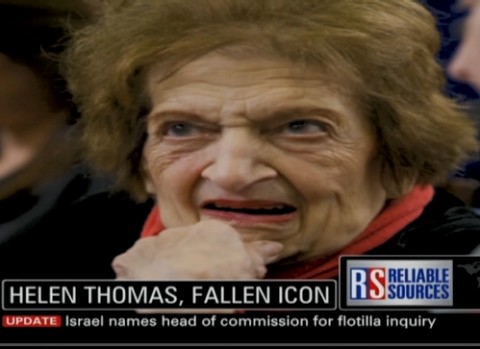
Kurtz: Helen Thomas Has Been Excused for Saying Questionable Things for Years

CNN’s Howard Kurtz on Sunday said an inconvenient truth that few in his industry would care to admit: “Helen Thomas has been saying all kinds of questionable things in [the White House] press room for the past decade, but her colleagues, for the most part, had given her a pass until now.” This indeed is the real lesson behind last week’s retirement of the nation’s longest living member of the White House press corps: she for years was allowed by her colleagues to regularly get away with what most of them knew was unacceptable behavior. Interesting that media members are learning this lesson only when one of their own falls from grace. The question is whether or not they’ll recognize that they should always be scrutinizing each other’s performance in order to maintain the integrity and professionalism key to an industry that is charged with policing government and the politicians that serve our very nation. This seems especially important given how the same people now admitting they let Thomas get away with media malpractice ignored all journalistic standards during the last presidential campaign and have continued to do so since Barack Obama was inaugurated. Consider that as you watch Kurtz and his panel discuss the Thomas affair on the opening segment of Sunday’s “Reliable Sources” (video follows with transcribed highlights and commentary, full transcript at end of post):   HOWARD KURTZ, HOST: Dana Milbank, has the White House Press Corps, where Helen Thomas’ views have been no secret, been protecting her for years?  KURTZ: Lynn Sweet, I know you like and admire Helen Thomas. Do you think she was cut some slack because she was in her ’80s…before this incident?    KURTZ: Well, because she had worked for UPI, but then she was a columnist, which ordinarily would not warrant you a front-row seat.    After playing some clips of absurd things Thomas has said in the press room in the past, Kurtz asked, “What correspondent or columnist gets to say things like that?” The Washington Post’s Dana Milbank answered, “Nobody else, I think, with the exception of her.”   KURTZ: But, see, if you look at some of the sound bites we just played, some of the questions that she’s asked over the years, I would agree, to some extent, she basically didn’t care what people thought of her. She was there to ask the kind of questions, particularly to President Bush, who she did not like, that she called one of the worst presidents ever. But is it the role of the journalists, even opinion journalists, to denounce the war in Iraq, to accuse the administration of killing civilians?   JEFFREY GOLDBERG, NATIONAL CORRESPONDENT, “THE ATLANTIC”: Well, there’s two sides to this. I mean, no. Obviously, you’re not supposed to be in the press room advocating for a Hezbollah opposition. KURTZ: But, Lynn, did it ever make you uncomfortable when Helen Thomas would talk about the brutal military occupation by Israel, or talk about the U.S. inflicting collective punishment against Lebanon and Palestine? Did that ever bother you?  LYNN SWEET, CHICAGO SUN-TIMES: Yes, it bothered me, but the — whether or not it bothered me, yes. KURTZ: But I wonder — here you have this room full of journalists, and they write about everybody else, and yet they don’t write about colleagues who do this sort of thing. GOLDBERG: We all have or have had grandmothers who occasionally say wacky things. And when you reach the age of 89, you know, you do get some slack.  (CROSSTALK) GOLDBERG: Well, and there are always lines. KURTZ: And the wacky grandmothers don’t have a seat in the press room and here on television.  Exactly. Kurtz was hitting on an important point here: this is the White House press room. Why was the “wacky grandmother” given a seat in the country’s most prestigious press venue for so many years and allowed to make these statements with cameras rolling? And why did her colleagues — who supposedly feel pride in their profession and the journalism industry as a whole — allow it to happen for so long without writing about it to the point that she was forced out long before this final embarrassing moment? As the segment moved to a close, it was Goldberg that really hit the nail on the head:  KURTZ: Do you think, Lynn Sweet, that the media are allowing this unfortunate controversy — and it is unfortunate — to overshadow this storied career that Helen Thomas has had?  SWEET: Perhaps not. Stories unfold, Howie, in chapters. The first chapter had to be the news of what she said. And I think in time there will be a balance. You know, she had this seat because she was a trailblazer, not because of her views on Mideast relations.  KURTZ: Agreed? MILBANK: I think it will be — the Germany remark will become the second half paragraph now, but not the first.  GOLDBERG: But let’s be real for a second. Helen Thomas has excoriated generations of White House officials, congressional leaders. She cut them no slack when they made a gaffe. KURTZ: And therefore?  GOLDBERG: And therefore —  KURTZ: The same standard should apply to her?  GOLDBERG: The same standard should apply to all journalists.   Indeed, and therein lies the larger lesson. For years, so-called journalists allowed Thomas to play the part of the White House press room clown with total impunity. Now, the industry has been tarnished by their lack of diligence. With the way these same folks have behaved in recent years — from their abysmal coverage of the last administration to how they helped the Democrats take over Congress in 2006 and how they enabled an inexperienced, unqualified junior senator from Illinois to become President of the United States — they had better understand the broader scope of this issue. After all, as Kurtz and Company pointed out, Thomas wasn’t the only journalist behaving badly. In the end, when you dishonestly protect one of your own from scrutiny — whether it’s a fellow journalist you like or a politician you support — you’re doing your industry and the nation a grave disservice.  Full transcript for those interested: HOWARD KURTZ, HOST: It came as a shock to much of the country when Helen Thomas, a White House fixture and icon, a trailblazer for female journalists, self-destructed before the cameras — a single video camera wielded by a rabbi, to be precise. The reaction to her anti-Israel diatribe was so overwhelming, that Thomas resigned this week as a Hearst newspaper columnist. But why was it such a stunner to so many people? Helen Thomas has been saying all kinds of questionable things in that press room for the past decade, but her colleagues, for the most part, had given her a pass until now. (BEGIN VIDEO CLIP) KATIE COURIC, CBS NEWS: A legendary career in journalism ends over some angry words about Israel. DIANE SAWYER, ABC NEWS: What happened to the 89-year-old fixture in the front of the briefings? UNIDENTIFIED MALE: It’s a very creepy and slightly chilling statement. RICK SANCHEZ, CNN: Helen Thomas seems to side with Hamas when it comes to Israel. With Hamas. KAREN HANRETTY, REPUBLICAN STRATEGIST: This is a woman who thinks that Jews should go back to the place where they were eliminated, where they were liquefied, and it’s Germany. (END VIDEO CLIP) KURTZ: The words that abruptly ended Thomas’ career were recorded by Rabbi David Nesenoff during a White House celebration of Jewish Heritage Day. RABBI DAVID NESENOFF, RABBILIVE.COM: Any comments on Israel? We’re asking everybody today. Any comments on Israel? HELEN THOMAS, FMR. HEARST COLUMNIST: Tell them to get the hell out of Palestinian. UNIDENTIFIED MALE: Any better comments than that? THOMAS: Remember, these people are occupied and it’s their land. It’s not Germany and it’s not Poland. NESENOFF: So where should they go? What should they do? THOMAS: They go home. NESENOFF: Where’s home? THOMAS: Poland, Germany. NESENOFF: So you think Jews should go back to Poland and Germany? THOMAS: And America and everywhere else. (END VIDEO CLIP) KURTZ: Joining us now to talk about this sad finale for Helen Thomas and what it says about Washington journalism, Dana Milbank, who writes “The Washington Sketch” column for “The Washington Post”; Lynn Sweet, Washington bureau chief of “The Chicago Sun-Times” and a columnist for PoliticsDaily.com; and Jeffrey Goldberg, national correspondent for “The Atlantic.” Dana Milbank, has the White House Press Corps, where Helen Thomas’ views have been no secret, been protecting her for years? DANA MILBANK, “THE WASHINGTON POST”: Well, protecting her in the sense that there was a great deal of fondness for her because of her history, because she was such an institution. I don’t think she’s ever said anything quite like this before. I think people will tolerate a stand against Israel as distinct from an anti-Semitic stance, basically, against Jews, which we heard her say there, so it was just shocking to hear that. Now, it wasn’t surprising that she held those views, it was shocking that she actually said it, I think. KURTZ: Lynn Sweet, I know you like and admire Helen Thomas. Do you think she was cut some slack because she was in her ’80s? LYNN SWEET, WASHINGTON BUREAU CHIEF, “CHICAGO SUN-TIMES”: Well, no, because she ended up losing her job over this — (CROSSTALK) KURTZ: But before this incident? SWEET: Well, before this incident, she was a singular person in the White House. People might not know it, but organizations are given seats in the press room, as you know, Howie, not individuals. And she had that seat as a recognition of her career as a trailblazer. So, yes, she was cut slack. KURTZ: Well, because she had worked for UPI — SWEET: She had this seat. KURTZ: — but then she was a columnist, which ordinarily would not warrant you a front-row seat. SWEET: Ordinarily, it wouldn’t warrant you a seat. You always would have entree (ph). You know, Dana could go to the press room anytime he wants, he just stands on the side. It was very special for Helen to have the seat that was part of her identity. MILBANK: ABC, NBC, CBS — SWEET: Right. MILBANK: — Helen Thomas. KURTZ: Dana stands on the side of a lot of events. (LAUGHTER) SWEET: Right, which is why the debate over who gets the seat is really not one that is parallel to Helen’s seat. KURTZ: The debate over the seat is of interest to about 10 people, and I wish the media would get off of it. Jeffrey Goldberg, were you surprised by the intensity of the reaction to those anti-Israel remarks to the point where she was basically pressured into retiring? JEFFREY GOLDBERG, NATIONAL CORRESPONDENT, “THE ATLANTIC”: Not really, because these remarks marked the first time that a philosophical concept advanced by Mahmoud Ahmadinejad, the president of Iran, had been voiced by a seemingly mainstream figure in America. This is not — as has been pointed out, this is not merely anti-Israel criticism of an Israel policy. This was — KURTZ: People criticize Israeli policies all the time. You have. GOLDBERG: Even I have. But this is something completely different. This is an idea that the most anti-Semitic figures on the world stage have advanced. It’s a kind of a — (CROSSTALK) KURTZ: The Jews have no right to be on that land? GOLDBERG: Not only the Jews have no right to be on that land, but they should “go back” to Germany and Poland, which is almost — not only absurd, but almost sort of comically cruel. It betrays either a profound ignorance of history or a lack of caring about history. KURTZ: But let’s take a look at some of the things that Helen Thomas has been saying and asking during the past 10 years in her role as a columnist in that White House press room. (BEGIN VIDEO CLIP) THOMAS: Does the president think that the Palestinians have a right to resist 35 years of brutal military occupation and suppression? It could have stopped the bombardment of Lebanon. We have that much control with the Israelis. TONY SNOW, WHITE HOUSE PRESS SECRETARY: I don’t think so, Helen. THOMAS: We have collective punishment against all of Lebanon and Palestine. SNOW: No, what’s interesting, Helen — THOMAS: And what’s happening — and that’s the perception of the United States. SNOW: Well, thank you for the Hezbollah view. THOMAS: Mr. President, you started this war, the war of your choosing. And you can end it alone today. Thousands and thousands are dead. Don’t you understand? (END VIDEO CLIP) KURTZ: Now, she’s there representing Hearst. What correspondent or columnist gets to say things like that? MILBANK: Nobody else, I think, with the exception of her. In fact, often, you’d get the answers, “We’ll take a break for this moment for Helen to do an advocacy minute,” or, “Thank you, Secretary of State Helen Thomas.” KURTZ: So you’re saying that press secretaries used her as a kind of comic relief? MILBANK: Well, yes. Just this nice, old lady. She’s saying some wacky. People — the rest of us would sort of roll our eyes and say that’s Helen being Helen. But there were also times when she would hold the president’s feet to the fire on very serious issues that had nothing to do with the Palestinians. SWEET: Well, particularly in Iraq. She kind of had another chapter of her life when the U.S. went to war with Iraq, because she was very skeptical of it and she was holding the then Bush administration’s feet to the fire on that. KURTZ: More skeptical, many would say, than many of the mainstream journalists who a lot of people think rolled over during that period. SWEET: Right. No, she had a lot of questions that turned out that people weren’t asking at the time. That’s why this is, I think, a bit — I think you used the term in your column, “a tarnished icon,” and that is why this is complex. She ended a career with a few-second statement that had all this background to it. KURTZ: But, see, if you look at some of the sound bites we just played, some of the questions that she’s asked over the years, I would agree, to some extent, she basically didn’t care what people thought of her. She was there to ask the kind of questions, particularly to President Bush, who she did not like, that she called one of the worst presidents ever. But is it the role of the journalists, even opinion journalists, to denounce the war in Iraq, to accuse the administration of killing civilians? GOLDBERG: Well, there’s two sides to this. I mean, no. Obviously, you’re not supposed to be in the press room advocating for a Hezbollah opposition. On the other hand, her lack of awe, the lack of awe that she felt for the presidency, certainly for press secretaries, was useful and a good part of democracy, and people should adopt that general pose more frequently. SWEET: Well, I think you need to separate out, because this is a journalism show. Almost anyone could go to a White House briefing. You can’t always get to a White House press conference and get called on. I’m often surprised on why more columnists don’t show up and just ask their questions, whether or not they (INAUDIBLE) advocacy or not. MILBANK: And as it is, there are all kinds of opinionated people in that room, and I often find that it’s one of the far right or far left people who ask that question. They say, oh, wait a second, wee didn’t know about that, and it starts the debate in a different direction with the mainstream reporters. KURTZ: But, Lynn, did it ever make you uncomfortable when Helen Thomas would talk about the brutal military occupation by Israel, or talk about the U.S. inflicting collective punishment against Lebanon and Palestine? Did that ever bother you? SWEET: Yes, it bothered me, but the — whether or not it bothered me, yes. Any time anyone says or makes a reference to the Holocaust in Germany in the way she did, one of the most horrible, horrible things that ever have happened, yes, it should bother not only me, by the way, but everybody that the Holocaust happened. So let me clear on that — sure. But having a debate about the Mideast situation, even in terms that aren’t pleasant to hear, is something that you hear all the time when you cover the White House and when you cover Washington. MILBANK: People ask ridiculous questions all the time about Obama’s birth certificate, about pedophilia. I mean, it is a circus if you actually watch — GOLDBERG: But I think we did discover this week a true red line. I think we did discover a true red line — don’t bring up the Holocaust, OK, in that way. SWEET: And that’s why, frankly, people often just rip off comparisons — oh, he’s a Nazi. Even the food Nazi bothered me because how can you compare — the soup Nazi. All those things, I think, really, people should think a little bit about what they’re talking about. KURTZ: But I wonder — here you have this room full of journalists, and they write about everybody else, and yet they don’t write about colleagues who do this sort of thing. Let me throw this back to you, Jeffrey Goldberg. You know, some critics out there say — I’m sure you’ve heard this — that this shows the U.S. press is pro-Israel and you get in trouble when you criticize Israel. And if Helen Thomas had said the opposite thing about the Palestinians, she’d still have her job. GOLDBERG: A, I don’t think that last point is necessarily true. If you gave this long diatribe about the Palestinians don’t exist, which is sort of the equivalent argument, I don’t think you’re going to last that long in the mainstream press. No. You know, I always refer to this discussion as the taboo that won’t shut up. Everybody argues all the time that you can’t say anything you want about Israel. If you’ve looked at “The New York Times” op-ed page over the last month, I think there have been 15 different denunciations about Israeli policies and behaviors by a plethora of regular columnists and guest columnists, and that’s fine. That’s fine. We’re talking about a different subject. KURTZ: Let me play a few words in the aftermath of this controversy by Fox’s Sean Hannity, who had this to say about the aftermath of Helen Thomas’s ouster — (BEGIN VIDEO CLIP) SEAN HANNITY, FOX NEWS: Yet, for decades, the left-leaning White House Press Corps embraced her, even rewarding her with a front row seat in the briefing room. (END VIDEO CLIP) KURTZ: So, it’s all the fault of you liberal reporters? MILBANK: Well, I think that’s just silly. Let’s point out that I think it was two or three years ago, Helen Thomas wrote a book excoriating the White House Press Corps for being a bunch of pansies and too soft on President Bush. So, I mean, we can’t have it both ways in this situation. So, the notion we’re protecting her, I mean, we’re protecting her in the sense that it was like the crazy uncle. It’s like, oh, that’s Helen being Helen. But nobody agreed with her. GOLDBERG: We all have or have had grandmothers who occasionally say wacky things. And when you reach the age of 89, you know, you do get some slack. (CROSSTALK) GOLDBERG: Well, and there are always lines. KURTZ: And the wacky grandmothers don’t have a seat in the press room and here on television. (CROSSTALK) KURTZ: Do you think, Lynn Sweet, that the media are allowing this unfortunate controversy — and it is unfortunate — to overshadow this storied career that Helen Thomas has had? SWEET: Perhaps not. Stories unfold, Howie, in chapters. The first chapter had to be the news of what she said. And I think in time there will be a balance. You know, she had this seat because she was a trailblazer, not because of her views on Mideast relations. KURTZ: Agreed? MILBANK: I think it will be — the Germany remark will become the second half paragraph now, but not the first. GOLDBERG: But let’s be real for a second. Helen Thomas has excoriated generations of White House officials, congressional leaders. She cut them no slack when they made a gaffe. KURTZ: And therefore? GOLDBERG: And therefore — KURTZ: The same standard should apply to her? GOLDBERG: The same standard should apply to all journalists. KURTZ: All right. Jeffrey Goldberg, Lynn Sweet, Dana Milbank, thanks very much for joining us this morning.

Go here to see the original:
Kurtz: Helen Thomas Has Been Excused for Saying Questionable Things for Years

Maryland Citizens Face Felony Charges for Recording Cops

Several Marylanders face felony charges for recording their arrests on camera, and others have been intimidated to shut their cameras off. That's touched off a legal controversy. Mike Hellgren explains the fierce debate and what you should do to protect yourself. A man whose arrest was caught on video faces felony charges from Maryland State Police for recording it on camera. “We are enforcing the law, and we don't make any apologies for that,” said Greg Shipley, MSP. Video of another arrest at the Preakness quickly made its way online, despite an officer issuing this warning to the person who shot it, “Do me a favor and turn that off. It's illegal to videotape anybody's voice or anything else, against the law in the state of Maryland.” But is he right? Can police stop you from recording their actions, like a beating at the University of Maryland College Park? The American Civil Liberties Union says no. “For the government to be saying it has the power to prevent citizens from doing that is profoundly shocking, troubling, and particularly in the case of Maryland, simply flat-out wrong,” said David Roach, ACLU. Under Maryland law, conversations in private cannot be recorded without the consent of both people involved. added by: Omnomynous

Lily Allen pregent

In Dec. 2007, Lily Allen announced she was expecting her first child with then-boyfriend Ed Simons. But in Jan. 2008, the singer revealed she had a miscarriage. Lily Allen made headlines in the U.K. recently when she told a radio interviewer she wanted to take time off from her music career to have a baby. Then on Monday, she made them again, after stepping out in London sporting a baggy dress – and fueling rumors that she was, well, expecting. Alas, the stork is not ready to pay Allen a visit

Read more here:
Lily Allen pregent

Iraq: Women forced into sex slavery

Rising numbers of Iraqi women are being sold into sexual slavery every year because of the waning economy and dire security situation. Human rights organizations are highlighting the plight of Iraqi women and young girls, sometimes as young as twelve, exploited by criminal gangs for profit. “The women trafficking trade is at its height,” Houzan Mahmoud, representative abroad of the Organization of Women's Freedom in Iraq said.

Continue reading here:
Iraq: Women forced into sex slavery






