Maybe the apocalypse is nigh: News Corporation kingpin Rupert Murdoch rang in 2012 on Twitter, dashing off his appreciation for in-house treats (“Great oped inWSJ [sic] today on Ron Paul. Huge appeal of libertarian message”), urban atmospherics (“NY cold and empty, even central park. Nice!”) and, naturally, the movies of Fox and its subsidiaries. Good news: The Descendants scored some much-needed awards love! Bad news: Said love came from a man who extolled equivalent appreciation for We Bought a Zoo . Hoo boy, now what? Saw Fox film Descendants. Thank God, one to be proud of. Star Geo Clooney deserves Oscar, maybe film too. Sat Dec 31 23:48:34 via Twitter for iPad Rupert Murdoch rupertmurdoch “Maybe film too”? What an endorsement! Why couldn’t it be more like this: I LOVE the film “we bought a zoo”, a great family movie. Very proud of fox team who made this great film. Sun Jan 01 15:44:03 via Twitter for iPad Rupert Murdoch rupertmurdoch Whatever. Nothing a quick hack from inside the office can’t fix, though first I might focus on swapping out Murdoch’s accompanying photo with something that doesn’t look like a near-sighted scrotum with lips. [via Deadline ]
Dear family Movieliners, it is with a heavy heart that I inform you that after three lovely years together — spent dissecting nearly every James Franco General Hospital performance , evaluating Sylvester Stallone’s shirtless evolution onscreen and trying desperately to make sense out of the Adam Sandler Box Office Paradox — I am setting sail for a new horizon. Although I am sad to leave my friends at Movieline, I am excited to report that beginning next week, I will be writing daily for VanityFair.com’s Hollywood Blog . Consider this a formal invitation to visit me at my new home. In the meantime though, thanks are in order. Thank you to the tirelessly intelligent S.T. VanAirsdale, the wickedly funny Seth Abramovitch and the reliably witty Kyle Buchanan, all of whom initially took a chance on me, entertained me endlessly during the work day and gave me confidence in my writing. Thank you to Christopher Rosen, who not only nurtured my work but proved to be an excellent friend and Internet conversationalist when it comes to television and planning funerals fitting for action icons. Thank you to Jen Yamato, for being such a sweet and encouraging editor with a borderline scary dedication to karaoke. (One day, I will join you on the dark side of Koreatown.) Thank you to Movieline’s critics Stephanie Zacharek and Michelle Orange for their dependably beautiful prose on even the most hopeless pieces of cinema. Thank you to Mike Ryan, for inspiring me with your original and entertaining interviews. Thank you to Mark Lisanti, for flooring me with your consistently hilarious Alan Smithee features. And lastly, thank you to Louis Virtel, who made me snort-laugh and be self-conscious of my monotone delivery more than any single person I have ever known. It was a pleasure being your droll Movieline sidekick for two plus years. And finally, thank you to the wonderfully articulate readers and commenters, who continually kept me thinking and laughing long after my posts had been published. This is starting to sound like and Oscar acceptance speech though and I am simply leaving an Internet writing job, so I’ll cut this short. I enjoyed you all over the past three years and am proud to say I wrote for Movieline . Best of wishes in the new year. As always, you can reach out to me about Lifetime movies, cats and jigsaw puzzles on my Twitter feed ( @juliewmiller ) and beginning next week, you can read my musings on Hollywood at VanityFair.com. Yours, Julie Miller
Post-yuletide holiday crowds flocked to the same trio of sequels that dominated the Christmas box office — Mission: Impossible – Ghost Protocol , Sherlock Holmes: A Game of Shadows , and Alvin and the Chipmunks: Chipwrecked — while Summit newcomer The Darkest Hour limped into theaters waaaay under the radar. Meanwhile, Tom Cruise will be ringing in the new year with a number 1 box office finish, made all the sweeter by projections that Ghost Protocol will overtake the $134 million domestic take of the series’ last installment by Monday. Dive into your Friday Box Office! 1. MISSION: IMPOSSIBLE – GHOST PROTOCOL : $10,700,000 ($113,589,000) 2. SHERLOCK HOLMES: A GAME OF SHADOWS : $7,650,000 ($117,654,000) 3. ALVIN AND THE CHIPMUNKS: CHIPWRECKED : $7,125,000 ($83,484,000) 4. THE GIRL WITH THE DRAGON TATTOO : $5,350,000 ($46,161,000) 5. THE ADVENTURES OF TINTIN : $4,900,000 ($32,387,000) 9. THE DARKEST HOUR : $1,700,000 (new) [Figures via Box Office Mojo ]
Phyllida Lloyd and Meryl Streep work a puny bit of flim-flammery in The Iron Lady : They turn Margaret Thatcher into a folk hero, a woman who, poor lamb, had to make sacrifices in her personal life in exchange for political power. This is a watery, artfully evasive picture, anchored by a stupendous feat of mimicry. Some people call that acting. In The Iron Lady , Streep plays Margaret Thatcher, and boy, does she play her: It’s not just the crafty prosthetics, the careful swooping of the powdery-no-color hair, the meticulously chosen jacket-and-skirt ensembles that conjure the chilly specter of the seemingly indestructible former Prime Minister of Great Britain. Everything Streep does — her strutting-pigeon walk, the way she purses her lips just so after making a particularly harsh pronouncement in the presence of her cabinet — suggests many hours’ worth of vocal exercises and scholarly dissection of video footage. Streep has obviously studied the hell out of Margaret Thatcher, but that isn’t the same as getting to the rotten core of her. The performance is neither sympathetic nor damning — it’s simply meticulous and unblinking, and it reads more as a failure of nerve than as an act of bravery. Yet Streep’s performance doesn’t exist inside a bubble, and it’s of a piece with the picture’s conception of Thatcher as a not-bad lady who actually had some good points, if you squint really hard. The Iron Lady focuses more on Thatcher’s personal and interior life, only brushing against her politics. It’s as if Lloyd and screenwriter Abi Morgan don’t want any of those old nasties — Thatcher’s crackdown on the miners’ strike of the mid-1980s, resulting in thousands of lost jobs; the institution of the poll tax; the insidious gutting of the National Health Service, at the hands of the woman who famously proclaimed “There is no society” — to intrude on their portrait of Thatcher as just a plain old grocer’s daughter with deep-rooted class insecurities and the kind of ambition that makes the male species cringe. Thatcher did, of course, make her male colleagues cringe, but The Iron Lady suggests that they cringed only because she was a threatening female, and not because they found her views politically and morally specious. It’s a bit of doublespeak that comes in handy when you’re making a picture about all that a woman must give up when she when she craves power and authority in a man’s world. Lloyd, Morgan and Streep are obsessed with those sacrifices, even though they can’t prove how authentic they might be in Thatcher’s actual brain: The picture opens, and continually returns to, Thatcher’s later, post-Prime-Minister years, as she’s toddling around at home in her housecoat and chit-chatting with her husband, Denis (played by the nearly always wonderful Jim Broadbent, who continues his track record here). She informs Denis that milk has gone up to 49p a pint — imagine! And nixes his just-for-fun idea of donning a silk turban with a suit for normal daywear. But it turns out that Denis no longer exists: He has died, and while Margaret accepts it logically, she can’t accept it emotionally. When her doctor, during a routine examination, asks her if she’s had any hallucinations recently, Streep’s Margaret flinches ever so slightly before responding, “No.” So you see, Margaret Thatcher, powerful as she was, was capable of being loved and, get this, actually loving . To a point: The story also flashes back to Thatcher’s younger days (as a teenager and young woman, she’s played by Alexandra Roach), driving away in her car to her new MP job as her two children, twins, run after the car, crying, “Mummy, don’t go!” Still, she puts the pedal to the metal — bad mummy! But that’s what you need to do if you want to run a country. The mid-period stuff in The Iron Lady focuses on Thatcher’s rise to power — by this time, she’s played by Streep, not yet obscured by age makeup, and addressing her fellow MPs in a series of prim, silly hats. When Thatcher loses the hats — as coached by her colleagues and mentors Gordon Reece (Roger Allam) and Airey Neave (Nicholas Farrell), the latter of whom would shortly thereafter be killed by an IRA bomb — she wins the general election. From there, she proceeds to choke off the power of the trade unions, stoke unemployment and institute tax policies designed to goad the poor into pulling themselves up by their bootstraps. But you don’t really see much of that in The Iron Lady , other than some cursory handwaving at the vague notion of lost jobs and montages made up of old riot footage. What you do see is Thatcher as channeled by Streep, being a tough old bird of a human being, a woman who, upon her engagement to Denis, announced, “I can’t die washing up a teacup!” Margaret Thatcher — at that point Margaret Roberts — was destined for greater things, and she got them. But Lloyd and Morgan — as well as Streep — are more fixated on the personal price Thatcher had to pay than they are on the damage she ultimately wrought. The picture reeks of sexist special pleading. The overarching tone is “Just look at what this woman had to overcome!” Lloyd might say in her defense that she wanted to make a personal portrait of Thatcher, not a political one. Clint Eastwood might say the same thing of his recent J. Edgar, which focuses more on J. Edgar Hoover’s closeted personal life and unhappiness than on the lives he destroyed in the name of patriotism. But when you’re dealing with figures whose decisions and policies have been so destructive, is it even possible to separate the personal from the political? And if it’s possible, is it advisable? The Iron Lady is a handsome-looking picture (the DP is Elliot Davis) with a handsome-looking star. Streep’s Thatcher, with those trilling, fruity vowels, that glint of superiority in her eye, is impeccable. But to what end? Streep gives us no real clues into Thatcher’s inner life — not that we necessarily want them. This is an oversimplified portrait disguised as a complex one. Nowhere in the movie is it mentioned, to suggest just one example, that Thatcher referred to those striking miners — people who were simply trying to make a living and provide for their families — as “the enemy within.” Some of us wonder, still, how Margaret Thatcher can continue to live with herself. Watching Meryl Streep walk around so ably in Thatcher’s skin isn’t enlightening; it’s more like a living nightmare.
From ‘Harry Potter’ to ‘Drive,’ MTV News mourns — and praises — the year’s best fictional deaths. By Kevin P. Sullivan Fred Weasley die in “Harry Potter and the Deathly Hallows, Part 2” Photo: Warner Bros It is traditional at the end of the year to look back on those we have lost in Hollywood. Usually this means a poignant montage of actors, actresses and crew members during the Academy Awards, but it should also be noted that plenty of fictional passings occurred in 2011 as well. They may have been memorable, sad, thrilling or even funny, but each movie death meant something, and if we were to look back on the characters that passed away this year, these are the five that would get the biggest applause. It should noted that this article contains nothing but spoilers. Sebastian Shaw (Kevin Bacon in “X-Men: First Class”) All it took was a coin through the skull to remind us why Kevin Bacon should be in more movies. His character, Sebastian Shaw, lived large and in style, choosing a submarine as his method of world travel and double-breasted suits as his villainous costume. When Magneto finally met up with him to serve up some revenge extra cold, Shaw ate it in one of the most memorable scenes of 2011 . Fred Weasley (James Phelps in “Harry Potter and the Deathly Hallows, Part 2”) Many characters didn’t live to see the end of the Battle of Hogwarts, but none hurt as much as the demise of one half of the ginger-haired duo. George may have lost an ear in Part 1, but he lost a twin brother during the series finale, and we were there with him. At the very least, we can all remember the fun times we had together and rest assured that there is still one genetically identical person walking Diagon Alley. Beth Emhoff (Gwyneth Paltrow in “Contagion”) The look of terror on Paltrow’s face from the trailer may rank among some of the year’s most horrifying movie images. Beth Emhoff’s death early in the film starts the chain reaction that sets the film’s wheels in motion, but none of the millions of the deaths caused by the virus are shown with as much intimacy. She may have been patient zero, but she’ll always be #1 in our hearts. Shannon (Bryan Cranston in “Drive”) Bryan Cranston’s Shannon didn’t have much time to accept his fate, and neither did we. Before we knew it, Bernie Rose (played by Albert Brooks) had declared it “over.” Even the toughest of moviegoers had to flinch at the sight of the razor blade cutting through the neighborly mechanic’s arm. Shannon added both comic relief and charm to a movie that benefitted so greatly because of it. Planet Earth in “The Tree of Life” and “Melancholia” The character we’re all closest with bit the dust not once but twice this year at the movies. It’s never an easy thing, watching the planet you’ve grown up on destroyed, just ask Princess Leia. But never has the destruction of our home world been shown with as much stunning cinematography as it was in mouth of these art house hits. Stick with MTV News as we count down the Best of 2011 , including the top Artists , Songs , Live Performances and EDM Artists of the year. For breaking news, celebrity columns, humor and more — updated around the clock — visit MTVMoviesBlog.com . Related Photos Best Movie Demises Of 2011
The Library of Congress today announced an eclectic batch of new inductees into the National Film Registry for 2011, ranging from no-brainers (Charlie Chaplin’s The Kid ) to fantastic finds (the 1930s-era Nicholas Brothers Family Home Movies ). And also: Silence of the Lambs ! Forrest Gump ! … El Mariachi ? Which of these 25 newly anointed selections, to be preserved on account of their cultural, historical or aesthetic significance, is the most surprising addition? The 2011 National Film Registry Additions : Allures (1961) Bambi (1942) The Big Heat (1953) A Computer Animated Hand (1972) Crisis: Behind a Presidential Commitment (1963) The Cry of the Children (1912) A Cure for Pokeritis (1912) El Mariachi (1992) Faces (1968) Fake Fruit Factory (1986) Forrest Gump (1994) Growing Up Female (1971) Hester Stree t (1975) I, an Actress (1977) The Iron Horse (1924) The Kid (1921) The Lost Weekend (1945) The Negro Soldier (1944) Nicholas Brothers Family Home Movies (1930s-1940s) Norma Rae (1979) Porgy and Bess (1959) The Silence of the Lambs (1991) Stand and Deliver (1988) Twentieth Century (1934) War of the Worlds (1953) I could be convinced of El Mariachi ‘s worthiness given Robert Rodriguez’s famed hardscrabble production legend and the fact that he’s created a manageable cottage industry for himself working on the periphery of Hollywood. And yeah, El Mariachi ‘s pretty good, but for my money it’s the weakest new addition of the bunch. Which is not to say it’s the most surprising; Forrest Gump was well-loved and somewhat groundbreaking in its time even if it feels cringe-inducingly dated now, but many of these selections are of a distinct era or creatively, socially, or technically significant. (Ed Catmull’s 3-D grad project A Computer Animated Hand is another inspired choice.) Besides, Groundhog Day made the list back in 2006. Groundhog Day . So here’s what I want to know: How the heck has it taken this long for Bambi to make the list? Read more on each selection from the Library of Congress’s press release over at the Library of Congress website . [ Library of Congress ]
2011 was a year of awful celebrity meltdowns and unimpressive Oscar bait , but that doesn’t mean it wasn’t a fabulous time for Movieline. After the jump, I’ll revisit my 10 favorite stories of the year — including the one that tainted hydrangeas for eternity. · Madonna Hates Your Flowers The most important filmic milestone of the year was W.E. , Madonna’s 100% adored feature that made a splash at Venice. Though I’d love to philosophize about that three-hour De Beers commercial some more, I’d prefer to revisit the W.E. scandal that rocked my year: Madonna’s disparaging comments about hydrangeas. Priceless. · Immaculate Conniptions I verged into vulgarity this year, testing my YouTube mettle with my new web series Verbal Vogueing . It’s immature, and therefore I’m proud of it. · Baddest (And Best) Movie Ever: Clue I’ve been chronicling Bad Movies We Love for over a year, and none were as good, ridiculous, legendary, poignant, or senseless as my favorite movie of all time, Clue . I ranked its 25 best moments for you. · Big Trouble for Sean Penn and Madonna in Little China: Shanghai Surprise I’m a human being, so I understand that Shanghai Surprise is an awful movie. But I still celebrate it because I truly love its campy, half-baked, shittily acted, abysmally conceived story. Revisit with me. · Helena Bonham Carter Throws Her Hat of Birds at Melissa Leo Julie Miller and I thought long and hard about this year’s Oscar for Best Supporting Actress and dreamed up an ideal scenario where Hailee Steinfeld wins the trophy and Melissa Leo, Helena Bonham Carter, Jacki Weaver, and Amy Adams fight near the footlights. My favorite line? Julie’s: “Christoph Waltz announces that the Best Supporting Actress Oscar is sponsored by Chili’s.” · Who’s Afraid of Shrieking Supporting Actresses? Oscar History! My favorite. I ranked the nuttiest, Oscar-winning supporting actress roles of all time, and a towering, drunken tour de force clocked in at #1. “Violence! Violence!” · Final Destination 5: Only 9 More Destinations Before It Starts to Get Really Final I love horrid movie posters, and Final Destination 5 ‘s was certainly the most disturbing of the year. Look, it’s a skull! A novelty golf bag! A beagle! Joan Rivers! · Extremely Loud and Incredibly Trivial Thomas Horn, the child star of the new and bad movie Extremely Loud and Incredibly Close , was once a Kids Week victor on Jeopardy! . Because I’m a trivia nut, I decided to judge his performance in the Tom Hanks/Sandra Bernhard joint based solely on his performance behind the Jeopardy! lectern. I am so nice. · Tales of Endearment Shirley MacLaine blessed the L.A. Film Festival with personal stories about Marilyn Monroe, the Rat Pack, Billy Wilder, and Alfred Hitchcock. I sat and gawked, loving every minute of it. Jack Black was there too, but who wants to hear about that? · I Say “See Ya” to Pia Finally, from the catacombs of our American Idol coverage is the one week America really got the vote right — when it sent home that overblown, scathingly dull soulster Pia Toscano. Hope you’ve enjoyed the year in cinematic news!
On the bus home from a night out at a lesbian club, Fort Greene teenager Alike (Adepero Oduye) swaps her tomboyish outfit for earrings and a pink t-shirt, something clearly not of her own choosing, something selected to appease her mother. Alike is 17 and closeted, at least at home. Her mom Audrey (Kim Wayans) is uptight, religious and almost quivers with the effort of seeing her daughter as she wants her to be and not as she actually is. While Alike’s closer to her father Arthur (Charles Parnell), a cop, he’s chosen to step back from the tensions at home and in his marriage. Liking boys and makeup comes naturally to her younger sister Sharonda (Shamika Cotton) — our heroine is alone in her own personal form of camouflage, trying to blend into the background wherever she goes. What sets writer/director Dee Rees’s sensitive feature debut Pariah (expanded from her 2007 short of the same name) apart from the standard coming out story is that Alike is just as much an outsider at the club as at home, adrift and uncomfortable while her more outgoing best friend Laura (Pernell Walker) picks up girls on the dance floor. She hasn’t found the place in which she feels she can be herself. Alike knows that she’s gay, but her understanding and acceptance of that fact doesn’t mean she knows where she fits, in the scene or out of it — she doesn’t easily fall into the divisions of butch and femme, and she doesn’t seems to do any better at school, where she’s a good student in whose writing a teacher has taken a special interest, but other dangles outside the established social groups. Pariah is a coming of age story that’s uncommonly aware of just how heartbreakingly important the trappings of fashion, of music choices, of hobbies are when you’re young — they’re symbols of everything you think you are or aspire to be, even as they’re woefully inadequate shortcuts to establishing your identity. Alike’s journey take place in a larger landscape of shifting identities — just as the lesbian community isn’t a monolithic entity, neither is the black neighborhood in which the majority of the action is set. Her family has worked its way into the middle class, and Audrey’s consciousness of this achievement informs her stiffness around the coworkers she clearly feels she’s a cut above and her overall fussy propriety. It’s this sense of the type of people with whom her family belongs that leads her to insist Alike hang out with the daughter of an acquaintance from church, Bina (Aasha Davis), as if enough time in each other’s proximity would make a friendship inevitable. Alike begrudgingly walks to school with Bina and hangs out with her on the weekends, and finds a connection with the girl she never expected, one that blossoms into a possible romance when Bina gives our heroine her first kiss. Bina’s the opposite of Alike in many ways, bold where the latter is shy, but also uncertain where she’s fully decided, and the halting tenderness with which their relationship builds is tinged with the knowledge that Bina is probably going to break her heart. Pariah wouldn’t work without Oduye’s luminous performance, capturing the emotional nuances of a character not prone to letting her emotions show. She makes Alike’s vulnerabilities clear through her defenses — Alike’s convinced she has the world fooled, but isn’t anywhere near as in control as she’d like to believe. It’s a lovely, subtle portrayal that’s deservedly been getting a lot of attention for Oduye, who originated the role in Rees’s short and who may also be familiar as the grocery store clerk Louis C.K. awkwardly follows home to try to ask out in the first season of Louie . It’s a performance that good enough to smooth over the fact that the film’s gears grind as it arrives at an ending that feels neat, with Alike finally confronting her parents and encountering the results we’ve been primed to expect from the outset. Pariah is a small story of a painful, formative era in its protagonist’s life, and it sometimes feels roughly hewn to fit into an arc it doesn’t necessarily need. It’s the intimate, unforced details — an exchange between Arthur and his friends at a store, the way Laura chooses to shut Alike out after feeling betrayed by her new relationship — that speak volumes more than the film’s obvious butterfly metaphor, and that attest to a filmmaker and actress worth keeping an eye on. Follow Alison Willmore on Twitter . Follow Movieline on Twitter .
There is a group of individuals whom Movieline would like to salute: The passionate, faceless people who lovingly record, in surprising detail and with confounding care, the full plot summaries for horrible movies on Wikipedia. Wikipedia movie plot historians, your day has come. I first recognized this phenomenon last month. While researching several pivotal roles in Kirsten Dunst’s career for the actresses’s 9 Milestones in the Evolution of… feature, I noticed (and greatly appreciated) that an Internet user had heroically outlined the entire plot of her long-forgotten and laughable 1998 television movie Fifteen and Pregnant . The plot summary is delivered in four straightforward paragraphs which remarkably do not acknowledge the ridiculousness of this poorly-scripted and self-righteous project. Here is just a taste… “The film opens with fourteen year old Tina having sex with Ray. A few days later Tina is sitting in the car with her mother and Tina’s mother asks her if she knows anyone who is sexually active at her age, or if she has ever been sexually active, and Tina nods her head yes, although her mother doesn’t know what she is admitting.” Granted, the person who was so moved by the melodramatic play-by-play of Fifteen and Pregnant that he/she rushed to his/her computer and tapped out a painfully accurate recap, is by no means a scholar. But skill or grasp of the English language is not the point here: The dedication is. For example, do you know how much you’d have to pay me to watch Troll 2 again and compose an entire 11 paragraph summary without a single critical inflection? (The most derogatory statement about the film in its Wikipedia entry is that it is “widely considered to be of poor quality.”) Do you know how severely you would need to threaten me before I typed out 1,000 words on the detestable Rob Reiner film North ? Do you know how many Target gift cards you would have to hire Woody Harrelson to strew onto a hotel bed Indecent Proposal -style before I agreed to not only view New Year’s Eve but to pen an earnest six-paragraph summary of this particular Garry Marshall’s holiday disaster-piece ? (The answers to these three questions are “a ton,” “very severely,” and “like, $10,000 worth.”) The heroic Wikipedia users who composed the above plot summaries may not have saved any lives. But they did save brain cells — brain cells that could have met a similar fate as the millions of those left to be swept up along with the neglected candy and self-respect on the floor of every Jack and Jill -screening multiplex auditorium in America last month. Because hopefully, some smart moviegoers elected to just read the Wikipedia plot summary of the film so that they could appropriately rag on it at the water cooler without paying for a partial Adam Sandler-performed lobotomy. Or maybe a few intelligent viewers decided against seeing the film after its detailed Wiki page informed them that the “comedy” would feature “cameos” from Bruce Jenner, Regis Philbin and Drew Carey. Or maybe that is all just wishful thinking and Wikipedia plot summary movie-going prevention is just a hope for the future. Either way, I am thankful for the bold Wiki user who dared to recount every minor plot twist in Showgirls so that I never have to re-watch the film to rediscover how much Cristal and Zach paid Nomi for a lap dance at the Cheetah ($500). So please, in honor of these Wikipedia movie plot historians, take a moment and scan through a few detailed recaps of your least favorite movies of all time. Recognize the effort, thank the faceless writers in whichever way you deem fit and maybe consider tapping out a few future plot summaries of your own. For without these loving recaps, human beings might actually have to sit through a screening of Gigli to fully recognize the film’s atrociousness. Follow Julie Miller on Twitter . Follow Movieline on Twitter .
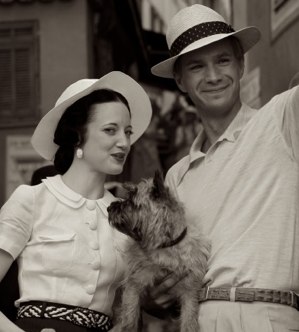
W.E. wasn’t just an undertaking for Madonna, who directed her Wallis Simpson/Edward VIII biopic with all the lavish heft of a gigantic watercolor landscape. It was also a labor of love for Andrea Riseborough, the 30-year-old actress playing Simpson, the American socialite whose romance with Edward led to his abdication of the throne in 1936. The film’s most enjoyable asset, Riseborough was saddled with making the polarizing Simpson a wholly charismatic figure — an Evita without the benefit of torch songs. She succeeds, and with her thoroughly photogenic Edward (James D’Arcy) in tow, she softens W.E. ‘s melodrama with fantastic ease. We caught up with Riseborough to discuss her fascinating director , her feelings about the subject matter, and the zaniness of the Venice Film Festival . You’ve been promoting this movie nonstop for months! Are you sick of corsets and gorgeous costuming at this point? Are the constraints of the couture caving in on you, so to speak? That’s very funny! No, I’m very much enamored with every different period. It’s so funny because people often say — or people talk about period pieces — and I never really faction different periods or divide them from one another. I just think that really everything is of a specific period whether it be 2016 or 1810. It was extraordinary, the architectural feats that some of the couture gowns entailed on W.E. entailed. You have no idea. It was extraordinary. But is it daunting to think of committing so much to the look and feel of a period piece again? It’s something I’m very familiar with. Because whether it is 2016 or 1810, it’s very arduous. Specificity in any project, even if it exists in the abstract [Laughs] or it exists in an alternate reality, there’s always a vision that everybody adheres to. Everybody very much passionately leans toward expressing that vision and the way we share it with the world. It’s something that’s very familiar to me, actually, I suppose is the answer to that. It’s something I enjoy very much. It’s transporting. You are stunning in this movie. You really have the face of a beautiful silent screen star, or a young Bette Davis. Have you seen Dark Victory ? Oh I have, yes! Very much a part of my lexicon as a child. Did you think your throwback looks would aid you in getting cast? Because you would definitely fit in with the stars of Wallis Simpson’s time. Not really, because when I’d been sent the script, I thought it was very unique. I wanted to explore a little more and was interested certainly in the character that was Wallis Simpson, when I went to meet with the director — but when I met her, I actually had what could only be described as sandy blonde hair and a false tan. I was playing a modern character elsewhere. I’d never seen myself in one particular period. I know that my face is pretty plain and can look reasonably attractive but can also look horribly unattractive, and it’s been something that’s been a real benefit to me — being a blank canvas. Muscularly, I can mold it anyway that I want to, if need be. Or I can completely relax it! So, no, I didn’t think that — no. What I saw ahead was like with any role, the journey of a transformation that was something so utterly far away from myself. It was something and is something I’m very fulfilled by. For the record, James D’Arcy also looks just like Anthony Perkins. You can tell him I said so. [Laughs.] Nobody’s ever told him, but I can e-mail him if you like! [Laughs again.] E-mailing him now. Madonna is known for being able to choose forthcoming trends, own them, and bring them to the pop culture fore. Before you met her, did you have any idea what would impress her, based solely on your knowledge of her before W.E.? Did you use that insight to get cast in the film? My desire was not to impress; I wanted to see what fueled her passion for the story. I wanted to know what her vision was for it, and whether she would respond to what I could her offer her as a potential duchess. I think it would’ve been — I would’ve been somebody else, actually. It’s not who I am, I suppose. I was interested to see what our complicit working relationship would be. That was exciting to me. The story of the duchess was something I thought would be potentially interesting to excavate. I wanted to see within what framework that might possibly happen. She, very fortunately, responded to what I had to bring to her. Really, we were artistically complicit from that point on, from the outset really. She’d seen me play Margaret Thatcher and this other character before, so she had a good grasp on the reality that I could inhabit somebody who existed and somebody who was young and innocent — this other character was young and innocent. One interesting thing about W.E. is the sheer continental difference in knowledge about Wallis Simpson. In the U.K., everyone knows. In the U.S., plenty of people know nothing about that era of British history. Oh, don’t do yourself down! I’m trying not to! But there’s definitely a gap in awareness about who Wallis Simpson was. How do you feel addressing that with different markets for the film? I think, really, the story transcends any historical context you might feel you need to put it in. Interestingly, of course, it was a reality. But what we have portrayed is our perception or version of the truth, Madonna’s version and vision of a woman who really existed. The heart of the piece is the thing that’ll tap on the door of the common man, if you will. Because, I hope, that was the thing that originally tapped on the door of the common man — every one of the working class areas that Edward visited, the working men so very much appreciated him, took him into their homes in a way that a prince had not been taken in before. It’s that same honesty and love and truth, I think, that people will feel and respond to. Wallis, she’d seen the writing on the wall. She ended up being as trapped as she imagined she would be, if he should abdicate, which he did as you know. It’s impossible for any one person — I mean, let’s not even reduce it to gender — it’s impossible for any one person to live up to the responsibility of the kingdom. How does one man fulfill a partner who has given up such an awful, awful lot for their relationship? Do you find yourself sorting out the fair criticism of W.E. from what might be considered a biased response to your director? Has the criticism been fair? I really believe that people have their own relationship with it. And I say “with it,” I mean everything that the film is. We were all part of making it. They can choose to absorb it and gain what is valuable from it any which way. I really have no opinion on it, to be truly honest, Louis. I know I’m incredibly honest to be part of something I found beautiful. That’s really all I know. Talk about the Venice Film Festival, where the world got its first taste of W.E. and the first swarm of responses to the film hit. Seemed pretty manic at the time. How do you remember it? It felt incredibly special. It was almost like our first offering at something we’d been so lovingly baking. The explosion that then ensued was quite breathtaking. It was almost funny being so surrounded by love. I’m just speaking as honestly as I felt it! Lastly, I heard you say that you and Madonna connected deeply in researching the “geeky” minutia of Wallis Simpson’s life. How deeply did that fixation go? Oh my gosh, that is such a long answer, Louis. Her fastidious research has no bounds! And that’s where the answer lies. When you approach something that you’re ignited by and are passionate about in such a way, really, until it seems to you’re getting to the point where no stone is unturned, only then can you stop. When you imagine chronicling an entire woman’s life from age 29 to 70, everything that went before 29 — since it must be taken into account — and everything that went after, you can imagine that’s no small feat. I ferociously lapped that up. I enjoyed it so much. But none of that is worth anything if you can’t just trust that it’s been inside of you so you can be present when you’re living out what might’ve been their life. Follow Louis Virtel on Twitter . Follow Movieline on Twitter . [Top Photo: WireImage]