Tag Archives: Los Angeles Times

School Named After Al Gore and Rachel ‘DDT’ Carson Built on Toxic Soil

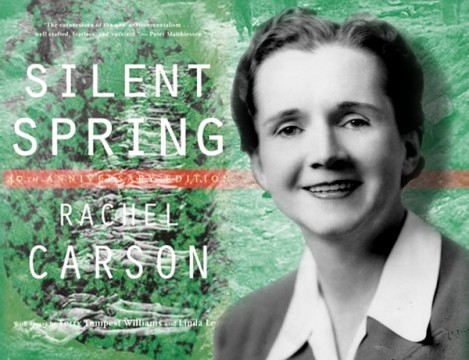
A new school will be opening in Los Angeles next Monday that is named after Nobel Laureate Al Gore and Rachel Carson, the woman almost single-handedly responsible for DDT being banned in the ’70s. Even more delicious than the names associated with the new $75.5-million Carson-Gore Academy of Environmental Sciences is that it was built on land thought to be highly-contaminated with various chemicals which could pose a threat to students. As the Los Angeles Times reported Sunday: Critics say the campus’ location poses a long-term health risk to students and staff. School district officials insist that the Arlington Heights property is clean and safe. And they’ve pledged to check vapor monitors and groundwater wells to make sure. “Renaming this terribly contaminated school after famous environmental advocates is an affront to the great work that these individuals have done to protect the public’s health from harm,” an environmental coalition wrote in a letter to the Los Angeles Unified School District. Making sure the school is safe “would be an even better way to honor their contribution to society.” Construction crews were working at the campus up to the Labor Day weekend, replacing toxic soil with clean fill. All told, workers removed dirt from two 3,800-square-foot plots to a depth of 45 feet, space enough to hold a four-story building. The soil had contained more than a dozen underground storage tanks serving light industrial businesses. Additional contamination may have come from the underground tanks of an adjacent gas station. A barrier will stretch 45 feet down from ground level to limit future possible fuel leakage. An oil well operates across the street, but officials said they’ve found no associated risks. Like many local campuses, this school also sits above an oil field, but no oil field-related methane has been detected. Groundwater about 45 feet below the surface remains contaminated but also poses no risk, officials said. You really can’t make this stuff up. Of course, readers shouldn’t miss the irony of Carson and Gore’s names being placed on a school that could end up being hazardous to the health of attendees. After all, Carson has the blood of millions nay billions of malaria deaths on her hands as a result of her paranoid book “Silent Spring” leading to the ban of DDT many years ago. As for Gore, if he ever gets his way, and nations around the world adopt cap-and-trade programs to limit carbon dioxide emissions, millions will likely die as a result of being kept from modern forms of energy creation. As such, it’s quite fitting a school be named after these two radical environmentalists that could end up harming the very students that attend it.  On the other hand, one could make the case that if the toxic fumes don’t hurt these poor, unsuspecting young souls, the environmental nonsense they’re being taught certainly will. It’s like rain on your wedding day.

More here:
School Named After Al Gore and Rachel ‘DDT’ Carson Built on Toxic Soil

A Brutally Liberal Cartoonist: The Secret to Newspaper ‘Credibility and Prestige’?

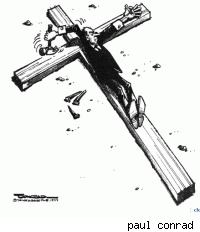
Long-time Los Angeles Times political cartoonist Paul Conrad has died, but the most interesting paragraph of his obituary in The Washington Post is the little hint by Post writer Matt Schudel that great newspapers only gain that reputation once they become liberal: He won his first Pulitzer in 1964, then left Denver for Los Angeles. Mr. Conrad’s incisive cartoons, which he drew six days a week, helped raise the reputation of the once-moribund Times, which had parroted the Republican Party line for decades . A similar version of this trope appeared in the Los Angeles Times itself in a story by James Rainey, but at least it suggested that there might be a difference between mediocre reporting and a Republican viewpoint. Conrad viciously attacked Nixon and Reagan with his pen, which was and is apparently the secret of media prestige: In the early 1960s, The Times was just beginning to rouse itself from decades of mediocrity. The newspaper had been politically and economically dominant in Southern California but a laughingstock in most of the country because of its mediocre journalism and blatant Republican boosterism. Otis Chandler took control as publisher in 1960 and, with Editor Nick Williams, decided to hire top talent to lift the paper to a higher level. The duo, determined to bring Conrad to Los Angeles, impressed him with their resolve. “The one thing I said,” Conrad recalled, “was, ‘Nobody tells me what to draw.'” The arrival of Conrad jarred many Times readers, not least the ultra-conservative members of the extended Chandler family, who already were displeased that their more liberal cousin, Otis, had taken control of the family business. “Nick [Williams] saw that Paul was this strident and very dedicated liberal and Nick thought that I would take a real beating, which I did,” Chandler said in a 2006 PBS documentary about the cartoonist. “But it was worth it, because he’s a real genius. He brought enormous credibility and prestige to The Times .”

See the original post here:
A Brutally Liberal Cartoonist: The Secret to Newspaper ‘Credibility and Prestige’?

LA Times To Hollywood: Please Ignore the Box Office Success of ‘The Expendables’

Last week, film writer extraordinaire  Christian Toto  fell under the delusion that yours truly was interesting enough to interview, and if you’re under the same delusion you can read the two-parter  here  and  here . Among other things, Toto asked me about the clout critics wield and the most common mistakes they make. Here’s a combination of my answers: Critics aren’t dumb, they know the public doesn’t much care which way their thumbs point. But critics do know that based on their opinions and reviews they can enjoy an influence over what kind of films get made. And that’s not a small amount of power. Culture is upstream from politics, after all. If you have 95 percent of critics savaging a faithful retelling of the Gospels as anti-Semitic, no matter how successful “The Passion” is, no one’s going to go near that subject matter again. And that’s the goal. Same with anything that comes close to patriotism or conservatism. Such cinematic rarities are frequently labeled “jingoistic, fascist or simple minded.” This is all done consciously and for a desired effect. You have to understand that when I look at the critical community I only see it for what it really is: a journolista cabal of left wingers deeply engaged in a cultural and ideological war, deeply committed to shaping the powerful messaging of sound and fury that emanate from our pop culture masters. As if to prove my point, this very morning Left-winger Steven Zeitchik of the L.A. Times ran  this propaganda piece ; a not very subtle attempt on his and the paper’s part to tamp down any enthusiasm development execs might have to copycat what made “The Expendables” such a box office success and cultural phenomenon: [emphasis mine] But the Stallone picture –  with its hard-charging, take-no-prisoners patriotism unbothered by the vagaries of the real world  (it takes place in a fictional country, for starters) and its caricature of freedom-hating enemies (“We will kill this American disease,” as the TV spot enticed us) – planted itself squarely in the old-school genre. And this weekend, the movie showed that there’s life in that category yet. … On one hand, it’s understandable that a movie of easy American heroism (OK, first-world Western heroism) would catch on. In fact, it’s surprising it didn’t happen sooner. Apple-pie-patriotism already is behind the success of a cable news network and supports large sections of the contemporary country music industry. Why not a film hit too? …. Political eras are, of course, rarely just one thing or another, and the movies we want to see in a given period are hardly monolithic.  But as tempting as it is to infer that the success of “The Expendables” shows a deeper cultural need, it may well be the wrong inference. When times are confusing, we want movies to reflect that confusion, and even to make sense of it. But we probably don’t want to pretend that confusion doesn’t exist. If you’re wondering why Hollywood is so out of touch with the 80% of their audience who aren’t liberal, part of the reason is certainly because much of the industry takes pride in being so, but you also have this kind of constant pressure from cultural enforcers like Zeitchik who disguise themselves as journalists. What Zeitchik’s quite purposefully doing here is toxifying “The Expendables” by ridiculing its simple worldview – as though the nihilism found in the moral equivalency preached by the likes of George Clooney and Paul Haggis is somehow “complicated.” He’s essentially sending out the message that whoring yourself to the movie-going rubes and their desire to see good conquer evil makes you dumb, uncool, and unsophisticated. So don’t do it. And the timing is perfect. Zeitchik wants to slap some of the excitement out of a box office success and affect the narrative before the Monday morning development meetings begin. He’s also offering talking points to his fellow travellers who attend those meetings. Therefore, even though Zeitchik is factually wrong, facts won’t much matter. No one wants the L.A. Times calling their movies uncool and simple-minded, and regardless of how big the hit, no one wants to have to defend “hard-charging, take-no-prisoners patriotism unbothered by the vagaries of the real world.” Not in this town. But again, Zeitchik is simply wrong. From an artistic point of view, “The Expendables” is a much more impressive achievement than the likes of the flood of “Syrianas” that have been bombing one after another at the box office over the past few years. A simple straight-forward story that’s actually about something is much more difficult to successfully craft than a confusing and muddled story that’s believes in absolutely nothing. Paint-by-numbers might not be Rembrandt but it takes more skill than throwing monkey shit at a canvas. The other false narrative Zeitchik tries to poison the development well with, is the false one that says the success of “The Expendables” is something of a fluke: Until this weekend, old-school action movies – defined, for argument’s sake, as films with a slew of explosions, a shortage of moral ambiguity and a triumph of physical effects over digital ones – had seen better days. It’s been nearly two decades since pictures of this sort were produced with any regularity by the studio system, and a lot longer since they were stateside successes. “Until this weekend?” Ah, no. Laughably, to bring home this point, after mentioning Stallone’s most recent “Rambo” and “The A-Team,” Zeitchik then offers up Jean-Claude Van Damme’s “JVCD” as further proof that films lacking in moral ambiguity “have seen better days.” Really? The one-location, self-referential piece of crap  that is ” JVCD ” is Zeitchik’s Exhibit C in this closing argument? But this is what happens when you’re in possession of a laughably biased theory in search of proof – especially when the surprise successes of  “300″ and “Taken,” not to mention “Salt,” the first “Transformers,” and “Gran Torino” – make a total fool of that moral ambiguity theory. That would be like me ignoring the “Bourne” trilogy while making some sort of argument that un-American, shaky-cammed action films starring hardwood don’t make money. There’s plenty of room at the multiplex and plenty of box-office cash for everyone’s worldview. Unfortunately for our side, the Zeitchik’s of the media world will stoop to pulling the “JVCD” Card in order to remove our seat at that table. UPDATE:  A commenter quite correctly points out that in his closing paragraph, Zeitchik talks about action films with heavy CGI effects and explosions, not just moral ambiguity – and that my counter-examples of “300,” “Transformers,” and “Gran Torino” don’t refute that point. Though I close my paragraph to explain that I’m specifically refuting Zeitchik’s moral ambiguity statement (which is most of the overall argument of his write up, and where I was most focused in my response), I could’ve been much clearer in that regard. As far as Zeitchik’s  full  argument, “Salt” and “Taken” are still better examples than “JVCD.” I would also add the hits “Man on Fire,” “Vantage Point,” and “Inglourious Basterds.” Crossposted at Big Hollywood

Read the original:
LA Times To Hollywood: Please Ignore the Box Office Success of ‘The Expendables’

Social Security: Government ‘Ponzi’ Scheme Turns 75 with $41 Billion Shortfall

This is a historic year for the largest government program: Social Security, which turns 75 in just a few days. The program is also running a deficit for the first time since 1983, and ahead of estimates. Initially, Social Security was created to provide supplemental income to elderly and disabled people who could not work, and was signed into law by President Franklin D. Roosevelt Aug. 14, 1935. Social Security is in the red six years earlier than forecasted, and for the first time since 1983 (the last time the program was “fixed”). Downplaying the significance of the problem, The New York Times reported March 24, that the program is facing a “small” $29 billion shortfall this year because the high 9.5 percent unemployment rate is cutting into payroll tax collections that fund the program’s benefits. Oh, and because there isn’t actually a trust fund with all the money previously collected by people paying into the system. Problems are mounting for the Social Security program which essentially is a government-created “Ponzi scheme.” It was a boon for the earliest entrants to the program like Ida May Fuller. She was the recipient of the first monthly retirement check, in 1940, and continued to collect until her death in 1975. Fuller worked only three years under the system: paying in $24.75 in taxes. By the time of her death she had collected a total of $22,888.92 according to the Social Security Administration. In 2010, the public is skeptical that they will get anything back from the system they pay into with each paycheck. A USA Today/Gallup poll found that three-fourths of people between 18 and 34 years of age don’t expect to get a Social Security check. Yet the news media have opposed much needed reform recently by ignoring or downplaying the problems with Social Security, and during the Bush years by attacking conservative reform proposals. They have allowed liberals to attack conservatives for wanting to make changes to the program, editorialized that Social Security will be just fine and practically ignored the failure of the program’s trustees to provide its annual report on time this year. The three broadcast networks have done little reporting on the postponement – even though the trustees are delaying bad news during an election year. The president’s debt commission is also looking into entitlements like Social Security to come up with policy solutions, but those won’t be announced until December – conveniently after the election. Every year the trustees of Social Security are required to publish their annual analysis by April 1. CATO Institute’s Jagadeesh Gokhale and Mark J. Warshawsky pointed this out in Forbes on July 12, 2010. “This year, however, the trustees have postponed its release indefinitely.” Why does that matter? Because, according to that article “The program’s financial condition continues to remain hidden from public view.” The trustees’ report was finally released Aug. 5, but when The New York Times announced its findings there was no mention that the report was four months late.The Times’ story also hyped the solvency of Medicare (something seriously in question), while admitting that Social Security is in the red. Nor did it point out that the shortfall had grown to a projection of $41 billion this year, $12 billion more than the Times had reported in March. Still, the Times quickly reassured the public it was “not a cause for panic,” according to Social Security commissioner Michael J. Astrue. The Times quoted the report, Social Security trustees, Treasury Secretary Tim Geithner and the co-chair of a liberal coalition, but not a single conservative voice. A Times editorial predictably spun the report by saying, “Social Security is holding up even in the face of a weak economy.” USA Today supplied its view on Social Security in an editorial Aug. 9. “[H]ere’s something Americans can cross off their be-very-afraid list: whether Social Security will be around so they can worry about all those other threats in relative financial comfort.” According to the liberal media, the problems facing Social Security are “easily fixable.” USA Today argued that it is only necessary to “economize elsewhere,” but that Washington doesn’t like to do that. CNN Money’s senior writer Jeanne Sahadi also said that fixing Social Security “should be a snap.” Sahadi’s solutions were not new: increase the retirement age, reduce growth in benefit levels and raising the cap on how much of wages is subject to the payroll tax. But she didn’t point out how politically difficult those solutions actually are, or the mainstream media’s past attacks on reform proposals. When President Bush attempted to tackle Social Security reform , the five major networks (ABC, CBS, NBC, CNN and FOX) aired twice as many left-leaning stories as right-leaning. Despite the media spin, “urgent reform is necessary” said Nicola Moore of The Heritage Foundation. Moore pointed out that Social Security has a $7.9 trillion shortfall “which means the program would require $7.9 trillion in cash  today! – to afford its promises.” Kathryn Nix, also of Heritage, wrote in June that “the early arrival of the need for a Social Security bailout should serve as a severe reminder to the Obama Administration that entitlement reform is needed now.” MSNBC Host Portrays Conservative Attempt at Reform as Attack on Middle Class According to at least one leftie pundit on MSNBC, attempts toward reform are actually attacks on the middle class in disguise. That’s what Keith Olbermann said on Aug. 9. “Republicans are tipping their hand somewhat about where they would get the money to pay for more tax cuts from the rich. Take it from the middle class. And make Americans work longer before they can retire,” Olbermann declared on his program. He cited Republican leader John Boehner’s comments about raising the retirement age to 70. Boehner has offered that possibility in June as one solution to make Social Security solvent, not , as Olbermann suggested, simply a way to “pay for more tax cuts from the rich.” Olbermann showed video of NBC’s David Gregory trying to force Boehner to say that he “favors” raising the retirement age. The MSNBC talking head didn’t bother to inform his viewers that the government is already paying out more for Social Security than it is taking in and will only get worse without intervention. The ‘Trust Fund’ Myth, a ‘Ponzi Scheme’ Despite the use of the phrase “trust fund” by politicians and journalists, to describe Social Security, the government has been spending that money and replacing it with Treasury bonds (IOUs) for years. A Nexis search for Social Security and trust fund found 68 newspaper stories at just four major newspapers in the past year. News articles such as the Aug. 6, USA Today story about Medicare and Social Security mentioned the “trust fund” as if it were a pile of money that “won’t run dry” until 2037. But Los Angeles Times business columnist Michael Hiltzik took it much further than the average news story. Hiltzik attacked those concerned with Social Security’s fiscal viability Aug. 8. In a piece entitled, “Myth of Social Security shortfall,” he said that the shortfall would be “covered” by “interest on the Treasury bonds in the Social Security trust fund.” Hiltzik further defended the notion of those bonds being “real money,” and lashed out at those “trying to bamboozle Americans into thinking Social Security is insolvent.” But it isn’t real “money,” any more than a person swapping debt by paying one credit card with another is paying with money. Unless revenue comes in that can cover the debts, the person is in trouble. CATO’s Michael Cannon criticized the Aug. 9, New York Times editorial on Social Security for claiming the program can still “pay full benefits until 2037” and current attention to the red ink does not “endanger benefits, because any shortfall can be covered by the trust fund.” Cannon reacted: “No. It. Can’t. Because there are no funds in the Social Security ‘trust fund’.” He characterized the entire idea as “an institutionalized, ritualized lie.”. One that news outlets continued to promote. Back in 2009, Mark Brandly , a professor of economics and adjunct scholar of the Ludwig von Mises Institute, explained how the system works and why it is deteriorating. Social Security is a “pay-as-you-go system,” he said. “[T]he government takes your money and gives it to Social Security recipients. In order to get workers to accept this system, the government promises to take other people’s money and give it to you when you retire.” Essentially, Brandly said it is a huge Ponzi scheme . Surprisingly, CNBC’s Jim Cramer who “loves” Social Security, completely agreed with the Ponzi characterization. In 2008, the ‘Mad Money’ host ranted that the Bernard Madoff $50 billion scam was not the “largest Ponzi scheme ever,” as some had been calling it. “We know the truth about Ponzi schemes,” Cramer said. ” We all know the name of the biggest Ponzi scheme in history and it’s not even illegal. In fact, it is run by the U.S. government. And the name of it – well they call it Social Security.” Cramer explained that by its very definition, Social Security was such a scheme: “In a Ponzi scheme, investors get the returns from the money paid in by subsequent investors and eventually the whole thing falls apart. The last people to invest get hosed. In Social Security, a program I love, workers pay for the benefits of current retirees and hope someday future workers will pay for their benefits – it’s all a Ponzi scheme.” Yet, even reporters who admit that the “trust fund” is a joke, continue to use the phrase instead of criticizing the politicians who perpetrate the myth that Social Security is solvent. Brandly also wrote that the system can only remain sound if “a lot of people die before collecting” check, and if there are more people paying in that collecting. But as more people were paying in the Social Security Administration (SSA) ran a “surplus,” but as government often does – it borrowed from itself leaving IOUs in the so-called “trust fund.” The program is in trouble for that very reason, and because people are living longer and the baby boomers are about to retire, leaving far fewer younger workers paying into the system. According to The CPA Online , Social Security paid out only to retiring individuals 65 and older beginning in 1942. Between 1937 and 1942, it paid out in lump sum to individuals retiring. Benefits did not extend to dependents and survivors until 1939. In 1935, when the program was created average life expectancy was below 65 years of age: 59.9 for men and 63.9 for women . Even by 1942, life expectancy was much lower than today (64.7 for men, 67.9 for women). The projected life expectancy for 2010 is 75.7 for men and 80.8 for women. Currently, people can begin collecting full benefits at age 66, or collect at a permanently lower rate beginning at age 62 or a higher rate if they wait until age 70. But the mainstream media attitude seems to be – don’t worry, it will all work out. Even the USA Today maintained optimism in an editorial that admitted (unlike its earlier news story) the fund is “just IOUs.” They still argued that it would politically impossible to ” renege ” on benefits for retiring Americans. Attacks on Private Accounts The network news media has historically provided a skewed perspective on Social Security and reform proposals. A three – part Business & Media Institute Special Report in 2005, when reform was a hot topic, found a left-ward tilt in Social Security stories twice as often as a conservative slant. That study, Biased Accounts, examined 125 stories on the five major networks and discovered that 44 percent of stories were slanted to the left, compared to 22 percent in the conservative direction. The remaining stories were neutral. Those findings might have looked drastically different if President Bush had not made a concerted effort stumping for Social Security reform. The president’s appearances and statements on the issue accounted for almost one-fourth of the conservative talking points in the study. One of the most popular talking points about Social Security was the liberal idea that personal accounts lead to “risky” stock investments. The argument that the conservative plan and/or the stock market were “risky” came up 53 times. Trish Regan even set her Feb. 5, 2005, “CBS Evening News” report against the backdrop of Reno, Nev., a popular gambling destination. Unsurprisingly, local worker Maureen Fager said about personal accounts, “This is Reno, Nevada. I know a gamble when I see it.” The financial planner they took her to, David Yeske, even claimed that humans aren’t cut out to deal with such matters though that is how he makes his living. “The human brain has been wired for social interactions, not analyzing numbers,” Yeske said. That same report also misstated the age of retirement for Fager and a 27-year-old worker. It was unclear whether Yeske or the reporter was making the mistake.

Ray Bradbury in Conversation with Steve Wasserman (part 2)

Author: truthdig Added: Sun, 27 Jul 2008 20:34:03 -0800 Duration: 545 Iconic author Ray Bradbury speaks with Truthdig literary editor Steve Wasserman about books and ideas. Part 2: The Book Review

http://flash.revver.com/player/1.0/player.swf?mediaId=1068758

View post:
Ray Bradbury in Conversation with Steve Wasserman (part 2)

Ray Bradbury in Conversation with Steve Wasserman (part 4)

Author: truthdig Added: Mon, 28 Jul 2008 00:33:29 -0800 Duration: 471 Iconic author Ray Bradbury speaks with Truthdig literary editor Steve Wasserman about books and ideas. Part 4: Love

http://flash.revver.com/player/1.0/player.swf?mediaId=1068790

Here is the original post:
Ray Bradbury in Conversation with Steve Wasserman (part 4)