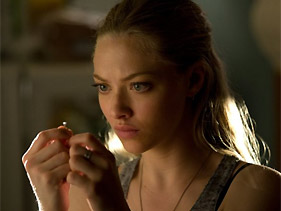
‘She has no choice but to go in the direction of the serial killer,’ actress tells MTV News. By Kara Warner Amanda Seyfried in “Gone” Photo: Saeed Adyani/ Summit Entertainment Amanda Seyfried has been stepping outside the proverbial box recently with her roles in films. The last time we caught up with the “Mean Girls” and “Mamma Mia!” star, she was fighting the Man with Justin Timberlake in the sci-fi thriller “In Time,” and this week, she has us on the edge of our seats in the suspense thriller “Gone.” The film revolves around recent kidnapping victim Jill Parrish (Seyfried), who is still trying to get over a series of harrowing, inexplicable events that occurred a year earlier, when she claimed she was kidnapped and buried in a hole in a ground. When Jill comes home from work one evening to find her sister missing, she is convinced that the same kidnapper has returned to torture her once more. Unfortunately for Jill, the people around her think she’s crazy, including the local police, and Jill has to take matters into her own hands to try to find her sister before something truly terrible happens. The story is told in such a way to keep the audience wondering if Seyfried’s character is really crazy and if the one police officer who believes her is actually the killer. When MTV News caught up with Seyfried recently, she revealed that she enjoys playing up the paranoid aspects of a femme fatale, but also explained exactly why Jill isn’t your run-of-the-mill damsel in distress. “She’s just the girl-next-door kind of character, and it kind of makes you realize that anyone is capable of anything if they put their mind to it,” Seyfried said. “She has no choice but to go in the direction of the serial killer, because he has her sister, and it’s a no-holds-barred really strong female character.” Check out everything we’ve got on “Gone.” For breaking news, celebrity columns, humor and more — updated around the clock — visit MTVMoviesBlog.com .
The films almost couldn’t be more different: Hugo is an epic, 3-D family film that wraps us up in a warm glow, and The Girl With the Dragon Tattoo is a chilling murder mystery set in the stifling Nordic winter. Robert Richardson and Jeff Cronenweth — the cinematographers (pictured above R-L) tasked with making these respective worlds believable — will contend this weekend for an Oscar for Best Cinematography (along with The Artist ‘s Guillaume Schiffman, The Tree of Life ‘s Emmanuel Lubezki and War Horse ‘s Janusz Kaminski). Movieline spoke with Cronenweth and Richardson about their approach and style on their nominated films as well as their recognition from the Academy. What did the narrative of this film demand of you in terms of style? CRONENWETH: A murder mystery in and of itself has its own set of dramatic license and techniques to implore. But with Dragon Tattoo being the first book of the incredibly detailed Stieg Larsson trilogy and set in the Swedish countryside during a particularly harsh winter, we inherited certain esthetic obligations, the most obvious one being the cold and how it affects the lives of our characters. It was imperative that we afforded the audience to appreciate that visually through quality and color of light and through sound effects. RICHARDSON: The narrative of Hugo slipped from the seed of Brian Selznick’s illustrations — in that respect all departments enhanced the reality of the world that Hugo lived within — that became the foundation of our style. How much did you collaborate with your director on the message of each scene? CRONENWETH: Well, there is always a conversation about the impetus of each scene and the purpose of each shot within that scene. Then on the shoot day, when we actually rehearse with the cast and block the scene, we apply those discussions but stay open to discovery. RICHARDSON: Communication with Marty [Scorsese] is extremely specific — there is not a shot within his storyboards that does not have a purpose — in the same light his concept of what each scenes “message” might be is a reflection of this degree of precision — in respect to collaboration — generally it is less about collaboration of origin of concept and more about collaborating on manner and methods of achievement of his vision. This year, there’s a mix of digital and film among the nominees for Best Cinematography. How much does shooting on film vs. digital matter to you? CRONENWETH: I still like the notion that some formats support certain stories better than others, and I like the idea that we are afforded the luxury of different story telling tools. But having said that I feel the gap between the two has closed for all intents and purposes. RICHARDSON: Digital capture and film capture both have their advantages and disadvantages. I shot Hugo on digital with the Alexa and am now in the process of shooting Django Unchained on 35mm anamorphic. I feel comfortable with either digital or film — the director and the project should determine the course of choice. Does this digital-film diversity among cinematographers make it a more exciting race, and how so? CRONENWETH : I think the drastically different subject matter and story styles are a more interesting conversation than the digital vs. film. Black-and-white silent-period movie, a 3-D children’s fairy tale colorful and dramatic, WWII fantasy about a horse beautifully epic and classic, a story of life shot free-flowing with available light crosscut with nature’s marvels, and a murder mystery set in the Swedish country in the middle of winter. RICHARDSON: I am uncertain about this question. The product should speak for itself. I sense that perhaps you are making too much of too little. In the end (I believe) not one of the projects is not in some manner a digital collaboration — the digital intermediate currently is placed between capture and presentation — the number of screens with which to view a film capture and traditional chemical treatment is on a rapid decline — most presentations are now digital cinema and that percentage will rise exponentially — was The Artist shot on black and white? I am uncertain, but I would hazard the guess that it was shot on color film and then in post had the color removed, meaning regardless of capture most projects at some point become digitized. With that in mind I would ask if you might tell me where does digital and film begin and or end. Furthermore, what is the percentage of films that you have viewed this year that were captured on film, processed, printed for dailies and distributed on film to the cinema? Sadly, cinemas with film as the primary source are disappearing. We need to remain open to change. That does not require one to divorce the past but to respect and process both the present and the future. Are there any colleagues you would’ve liked to see nominated for best cinematography this year? CRONENWETH: Newton Thomas Sigel for Drive . RICHARDSON: Far too many to list. Who is accompanying you to the ceremony? CRONENWETH: My beautiful girlfriend Tyne Doyle. RICHARDSON: My wife, Stephanie Martin, will be accompanying me to the Oscars as she did to the BAFTAs. How are you following this film? What is your next project? CRONENWETH: Directing commercials at the moment and reading scripts. RICHARDSON: I followed Hugo with World War Z (Marc Forster), and I am currently filming Django Unchained (Quentin Tarantino). MORE 2012 OSCAR ROUNDTABLES & CHATS Best Costume Design Best Documentary Feature Best Foreign-Language Feature
In the vigilante fantasy Gone , Amanda Seyfried plays Jill, a young Portland woman who can’t shake the memory of her abduction a year ago. She managed to slip through the guy’s clutches – he’d been holding her at the bottom of a deep pit in a sprawling local park – but the local cops, after finding no evidence of said hole (it’s a very big park), decided she made the whole thing up. Then one night Jill’s sister (Emily Wickersham) goes missing in a similar fashion: When Jill goes to the cops for help, they eye her warily, all except newbie detective Wes Bentley , who purrs at her creepily, in a red-herring sort of way. The thing about Seyfried is that she does look a little – OK, a lot — like a crazy waif, capable of making up any old thing and getting you to believe it by blinking those saucer-sized Blythe-doll eyes. She does a lot of that here, and she’s part of what makes Gone reasonably effective: Seyfried can look fragile, feral or a combination of both. Her skin is so translucent that she looks something like a pond creature, delicate and mysterious but also capable of staying underwater for a long, long time without breathing – in other words, she can surely take care of herself. Which is why you never worry too much about her character in Gone – you know she’ll come out on top, but it’s fun to doubt her here and there along the way. The picture is very simply constructed, using a minimum of tricks as it works its way toward its inevitable conclusion. (The director is Brazilian filmmaker Heitor Dhalia; the script is by Allison Burnett.) Essentially, Jill spends a day following a sequence of clues: She finds a possibly significant hardware-store receipt and treks to the establishment to quiz its super-friendly owner. (You know, the kind of guy who’ll sell you duct tape, a shovel, a flashlight and a mini-saw, chuck it all in a paper sack and say, “You have a great day now!”) En route to her prey, she queries a slacker kid about a mysterious fellow who’s been living in a local divey hotel. The kid warns her that the man in question is kind of shady: “My girlfriend says he has rapey-eyes.” Whatever those are – and it’s all too easy to imagine – you wouldn’t want to meet them in a dark alley, or at the bottom of a deep hole. As vigilante thrillers go, Gone is actually kind of subtle – perhaps too subtle. The movie repeatedly tosses the “Can we believe her or can’t we?” coin to the point where we don’t even have to guess. But ultimately, the plot doesn’t really hinge on who the would-be killer is, or even on the question of whether or not we can believe Jill. The more resonant question is, What happens when authority figures think they don’t have to take a pretty, sweet-looking girl seriously? The creepiest thing in Gone isn’t the inevitable showdown between Jill and her prey; it’s the way the cops stalk her (she’s toting an illegal firearm, which, they’ve decided, makes her Public Enemy #1), talk about her behind her back as if she were just some random loony (she did spend time in a mental hospital), and use the people she trusts to help reel her in. The aura of slow-burning paranoia is the best thing about the picture, though it’s not enough to fully sustain it. In the end, Gone really does have to be about Jill’s being smart enough to outwit her possibly imaginary nemesis – that’s what the audience comes to see, after all. Seyfried, a mini-Valkyrie with flaxen hair, can take care of herself all right. Still, those moments where you think she just might be an attention-seeking hysterical cutie-pie are exactly what gives the movie’s ending its satisfying click. Seyfried has spent too much time lately in vehicles that aren’t worthy of her, Red Riding Hood being the most egregious example. Gone at least takes her seriously – except when, to delicious effect, it doesn’t. Follow Stephanie Zacharek on Twitter . Follow Movieline on Twitter .
‘300’ actor reportedly entered treatment three weeks ago for substance abuse and ‘pain management.’ By Jocelyn Vena Gerard Butler Photo: George Napolitano/FilmMagic Gerard Butler is currently seeking treatment at the Betty Ford Center. According to TMZ , the actor is in rehab for a number of substance-abuse problems including prescription drugs and cocaine, but the focus of his problems are in “pain management.” The site reports that his problems stem back to 2006, when he was shooting “300” and the physical demand took a toll on him. The problem was reportedly aggravated on December 18, when he hurt himself on the set of “Of Men and Mavericks” while surfing. He reportedly entered the rehab facility three weeks ago after he realized he had been using prescription drugs too much and didn’t want it to become a full-on addiction. The site reports he is expected to leave sometime Friday (February 24). He actually opened up about the surfing incident when he appeared on “The Graham Norton Show,” calling it a “pretty close call” back in January. “The movie that I’m making is about big surf. I had been out there paddling … and then suddenly these waves came out of nowhere. I’m paddling on my board and it came and it was about 30 feet high. I was under… I ripped my leash off. I’m just tumbling, tumbling, tumbling. And then I felt the next wave go. All I’m thinking is, ‘There’s a whole film crew out there,’ ” he recalled. “I’ve had a few hairy experiences in training for this movie. This time, I was under for almost a minute.” The incident took place at Maverick, a surf site near Half Moon Bay, California. The film follows Jay Moriarty, a famed young surfer who died at 22 free-diving. Butler plays his mentor, Frosty Hesson.
Critics are a bit grossed out by the raunchy comedy but still charmed by leading man Paul Rudd. By Kara Warner Paul Rud and Jennifer Aniston in “Wanderlust” Photo: Universal Fans of the big-screen pairing of Jennifer Aniston and Paul Rudd have likely been waiting for the two likable actors to reunite since their 1998 romantic dramedy “The Object of My Affection.” At long last, that wait is over with the release of “Wanderlust,” a comedy in which Aniston and Rudd play a stressed-out Manhattan couple who end up traveling through a hippie-ish community that teaches them a lesson or two about what’s really important in life. The critical response is at 55 percent “Fresh” over at Rotten Tomatoes , with some folks enjoying the awkward humor and unflappable charm of Paul Rudd and others having issues with Rudd and Aniston’s schtick. Read on as we frolic through the “Wanderlust” reviews! The Irresistible Charm of Paul Rudd “Paul Rudd is the best friend a movie comedy can have. He always delivers the goods and something extra, usually something wild and weirdly wonderful. In ‘Wanderlust,’ Rudd lets the funny fly. Like the movie he’s in, Rudd only seems normal. Inside, it’s all deliriously unhinged. Rudd plays George, an uptight Wall Street suit squeezed into a Manhattan micro-loft with his documentarian wife Linda (Jennifer Aniston) until the recession shuts them both down. Off they go to Georgia where his idiot brother (Ken Marino, the film’s co-writer) offers him a job in his porta-potty business. Unacceptable. So George and Linda take shelter in Elysium, a commune where craziness reigns along with pot, acid, dodgy hygiene and free love. When the luscious Eva (Malin Akerman) offers to get it on with him, George unravels his straight laces. Here comes the Rudd time capsule moment: In a mirror, George rehearses talking dirty to Eva, taking the word ‘dick’ and stretching it into syllables of near-pornographic hilarity. It helps that Rudd is once again working with director and co-writer David Wain, as he did in ‘Role Models’ and the immortal 2001 indie ‘Wet Hot American Summer.’ ” — Peter Travers, Rolling Stone The Comedy and Quirk Factors “In sophisticated comedy, what’s funny is the tension between proper manners and the nasty or sexy subtext. Whereas in low comedy, there are no manners, and the nasty or sexy subtext is right there on the surface. And then there’s ‘Wanderlust,’ in which the subtext is blasted through megaphones — the characters say so insanely much you want to scream. The satire is as broad as a battleship and equally bombarding. But it takes guts to do a comedy this big without gross-out slapstick, and the writers and the actors are all in. … You say it sounds like a bunch of stereotypes — and 40-year-old stereotypes? The defense concedes the point. It’s not fresh terrain. But this tribe of hippies is also a tribe of marvelously inventive comic actors doing a fair amount of inspired improvisation and grooving on the mindset.” — David Edelstein, NPR The Final Word, Pro-Con-Pro Style “The role of an uptight fish out of water is what Rudd was born for, and he plays George with the congeniality and improvisatorial brio for which he’s become deservedly famous. He and Theroux, who’s barely recognizable beneath a thatch of long hair and a beard, deliver the most well-earned laughs in ‘Wanderlust,’ which otherwise traffics in tired jokes about menstrual cycles, placenta soup and rubbing your fingers together instead of clapping. … Between this film and last summer’s ‘Horrible Bosses,’ Aniston’s coyness — starring in explicit movies without having to be explicit herself — seems to be becoming her stock in trade. It’s not a particularly commendable one, and ‘Wanderlust’ does little to disprove that she’s still a star more suited to TV rather than the big screen. As for Rudd, he still has charm to burn, even playing a type he’s long since outgrown. Like George observing the overgrown children of Elysium, it might be time for Rudd to move on.” — Ann Hornaday, The Washington Post “The production has all the style and subtlety — and, admittedly, the exuberance — of TV sketch material. A psychedelic sequence makes Madonna’s halftime show look like high art. Both the straight and hippie realms are populated by parallel groups of fevered eccentrics; the cast includes Mr. Marino, Justin Theroux, Malin Akerman, Joe Lo Truglio, Kathryn Hahn, Kerri Kenney, Lauren Ambrose and Linda Lavin. Alan Alda is the commune’s venerable founder, Carvin, whose brain long ago failed the acid test. ‘Wanderlust’ is nothing if not strenuous, strident and gross, and most of it fails the comedy test.” — Joe Morgenstern, Wall Street Journal “There are so many things to feel guilty about liking in the pure and prurient guilty pleasure that is ‘Wanderlust.’ Starring Paul Rudd and Jennifer Aniston, this is a comedy of no manners about finding your bliss and escaping the modern grind. The laughter is served up naughty and nice, and frequently au naturel, earning it an R rating when perhaps RR (really raunchy) would have been more appropriate. Appropriateness, however, has pretty much been jettisoned by the filmmakers, who have opted instead for the good-fun-found-in-bad-taste tradition of ‘The Hangover.’ Directed by David Wain and co-written with his frequent comic collaborator, Ken Marino, the film is, overall, a very wobbly affair starting with all the dangling naked body parts that greet George (Rudd) and Linda (Aniston) when the couple pulls into a free-love commune they mistake for a B&B.” — Betsy Sharkey, Los Angeles Times Check out everything we’ve got on “Wanderlust.” For breaking news, celebrity columns, humor and more — updated around the clock — visit MTVMoviesBlog.com . Related Videos MTV First: Paul Rudd & Jennifer Aniston Related Photos ‘Wanderlust’
The bangers were out in full force in Hollyweird Thursday for the 5th Annual Essence Women In Hollywood Luncheon. There were so many pretty ladies in the building, but we were kinda digging on Tatyana Ali and Kelly Rowland’s copper colored sequined get ups the most. If you had to choose, Who Looked More Bangin’? Kerry Washington also looked especially chic. Lots more photos from the event below: WENN More On Bossip! Smackdown! The Chris Brown/CM Punk Feud Is Getting Pretty Intense! “I Will Choke You” And Breezy Responds! Can’t Get It Up: 10 Foods That Might Be Choking The Life Out Of Your…Libido Tell ‘Em Why You Mad: Janet “Aunt Viv” Hubert Writes An Open Letter To Wendy Williams Blaming Her For Whitney Houston’s Downfall Cake Cake Cake Cake! The Stars With The Wildest Birthday Parties
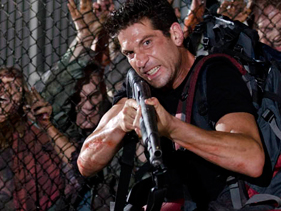
MTV News speaks with Robert Kirkman about what fans of the undead can expect from Oakland, California, convention. By Josh Wigler Jon Bernthal as Shane Walsh in “The Walking Dead” Photo: AMC If the worst should happen and a zombie apocalypse occurs this weekend, there’s no safer place in America to be than Northern California: “Walking Dead” creator Robert Kirkman will be in Oakland as part of the inaugural Image Expo , greatly increasing your survival odds if a pack of flesh-hungry walkers swarms the scene. “The Image Expo is an Image-centric comic book convention, so all of the guests have something to do with Image Comics,” Kirkman told MTV News during a recent phone interview. “All of the Image founders will be there, as well as new creators who are doing comics with Image this year: Ed Brubaker, Brian K. Vaughan, we have Jonathan Hickman coming here … all kinds of cool guests.” Running from February 24-26, the first-ever Image Expo makes its debut during the 20th anniversary of Image Comics. Kirkman, a longtime Image reader and current partner at the company, considers the anniversary a milestone achievement for a publisher that originally launched with a very uncertain future. “There were a lot of naysayers back in 1992 when the company was formed, saying they’d be gone within six months,” Kirkman said. “For Image to still be around, still generating new ideas and content and bringing in new creators into the industry, taking a lot of chances on people who’ve never been published before, that’s one of the things that Image does the best. It’s really cool that this vision of a company created by creators for creators, that offers the greatest creator-owned deal in the industry and gives everyone the kind of freedom every creator wants to have, is still standing.” Indeed, Image has plenty of new creators to brag about going into 2012. Kirkman identified “Captain America” writer Ed Brubaker’s new thriller “Fatale” as one of the books he’s most excited for this year. “Y: The Last Man” scribe Brian K. Vaughan’s upcoming sci-fi epic “Saga” is another of Kirkman’s must-read books in 2012. But Kirkman is equally excited about the arrival of some new creative voices at Image this year, including the company’s onetime PR and marketing coordinator Joe Keatinge, who launches a new series titled “Hell Yeah” in early March. “There are a lot of things he’s involved in that I’m very excited about, but the fact that he’s launching a creator-owned book, ‘Hell Yeah,’ is really great,” Kirkman said about Keatinge’s upcoming projects. “Image is the place that brings in new talent and shepherds them into the comics industry, and I see big things from this Keatinge kid.” Of course, Kirkman has plenty of his own books he’s bringing to the table as well. During Image Expo, Kirkman will champion some of his fan-favorite titles including “Walking Dead” and “Invincible,” as well as his new comic “Thief of Thieves” that debuted from his Skybound imprint earlier this year. “It’s about a guy named Conrad Paulson who lives a double life as an international thief named Redmond, who is rumored to be the greatest thief who ever lived,” Kirkman said of the book’s premise. “But he has a problem: he chose his thief life over his personal life, and he has an estranged ex-wife and a son he’s never talked to. He has a ton of regrets. The book is about him trying to get his life in order and turned around, turning his back on his career as a thief… but finding that he is completely and utterly unable to do that. He’s completely addicted to the thrill of stealing objects. He tries to work around that by working out a way to steal for the greater good.” Taking a page from his “Walking Dead” television experience, Kirkman is implementing a writer’s-room approach to “Thief of Thieves.” Rather than writing the book all on his own, he’s working alongside an unknown number of other writers — including “Morning Glories” scribe Nick Spencer — to add even more voices to his latest creative endeavor. “It’s been a lot of fun working on ‘The Walking Dead’ in the writer’s room. I’ve grown to respect that method of crafting stories, so I figured I’d give it a shot on a comic book,” Kirkman said. “It’s cool to sit down with other writers — currently unnamed, but we’ll be making announcements soon — and plotting out the story in the same way we’d be doing it on a television show. Having those different brains in the mix, people with different backgrounds generating different ideas and adding to the stew of the story we’re putting together is very cool. When you sit down and read the first 25 issues of ‘Thief of Thieves,’ you’re going to see all these different ideas at work. It’ll be cool to see how it all comes together.” Kirkman fans traveling to Image Expo to take a bite out of the writer’s biggest hit to date, “Walking Dead,” won’t walk away disappointed either. The convention will host variant editions of “Walking Dead” #94, as well as a select number of limited-edition “Walking Dead” watches . And, of course, there’s that little AMC series to consider as well. “We’ve got a panel called ‘Walking Dead’ Live where [‘Talking Dead’ host] Chris Hardwick will be interviewing myself and [actors Norman Reedus and Steven Yeun] together on a panel,” Kirkman said. “We’ll get to do that live before a panel audience, which should be pretty exciting. We’ll also have autographs, signings, all that cool stuff. We might even play ping pong with people. I cannot confirm that, but we’ll see. We’re going to be having all kinds of fun!” Are you heading to Image Expo this weekend? Sound off in the comments section or hit me up on Twitter @roundhoward ! For breaking news and previews of the latest comic book movies — updated around the clock — visit SplashPage.MTV.com .
As Academy Awards night approaches, the Talk Nerdy team reviews the biggest surprises, disappointments and favorites from 2011’s nerd films. By Josh Wigler Daniel Radcliffe, Rupert Grint and Emma Watson in “Harry Potter and the Deathly Hallows, Part 2” Photo: Warner Bros. Pictures The 2012 Oscars are upon us. The biggest night in Hollywood is set to go down Sunday, and when all is said and done, only one film will be crowned Best Picture. Of course, with only nine films in the Best Picture race, the Academy Awards have neglected to acknowledge some of the past year’s biggest and brightest gems — but geeks and genre fans know better: The nerd community enjoyed a truly spectacular 2011, as comic-book movies swarmed theaters with an astonishing level of quality in tow. Some of the year’s greatest performances came not from the likes of George Clooney in “The Descendants” or Jean Dujardin in “The Artist,” but from Michael Fassbender and Tom Hiddleston as tortured souls armed with superhuman gifts — yet neither of these men were nominated, snubbed alongside the countless other deserving individuals who dabbled in 2011’s incredible blockbuster scene. Chief among the snubs, as we’ve said time and time again: “Harry Potter and the Deathly Hallows: Part 2,” the stunning conclusion to the epic “Potter” saga. Warner Bros. campaigned hard to get Oscar love for its long-awaited grand finale, and while fans kept their fingers crossed for a Best Picture nod and Best Supporting Actor recognition for Alan Rickman, it never happened. The Academy can explain their decisions however they like, but there’s no skirting the issue: “Potter” got snubbed, plain and simple. In short, though 2011 was a phenomenal year for movie nerds all over the world, the Academy did not share our interests. They chose to not recognize the brilliant work of Andy Serkis in “Rise of the Planet of the Apes,” or honor the conclusion of one of the greatest fantasy franchises of all time in “Harry Potter.” Instead, it’s a dead heat between “The Artist” and “The Descendants,” much to the excitement of … who again, exactly? But the Talk Nerdy team knows better: We selected our biggest surprises, biggest disappointments and overall favorites from 2011’s nerdy movie offerings in this week’s latest episode. See if you agree with our picks in the video above — and if you don’t, you can always disagree with our choices in the comments section below. The MTV Movies team has the 2012 Oscars covered! Stick with us for everything you need to know leading up to the awards show, and on Sunday, February 26, tune into MTV.com at 5 p.m. ET for our two-and-a-half-hour red-carpet live stream and updates on the night’s big winners. To join the live conversation, tweet @MTVNews with the hashtag #Oscars. Related Videos Talk Nerdy 2012 Oscar Nominees Related Photos 2012 Oscar Nominees
You may know Sidney Poitier as the first black man or woman to win an Academy Award for Best Actor, but how many of his movies have you actually seen? Below is a list of his 10 best films, watch a few for the first time or watch them again and enjoy a true master at work. Poitier was born in 1927 in Miami, Florida, to Bahamian parents, and he grew up in the small village of Cat Island, Bahamas. At the age of 16 he moved to New York City and soon began working as a janitor for the American Negro Theater in exchange for acting lessons. After performing in plays throughout the 1940s he made his acting debut in the 1950 film “No Way Out. No Way Out.” The rest is cinematic history. Sidney Poitier Bio from PBS Disagree with the list? Did we miss one? Let us know what you think in the comments area below. 10. The Bedford Incident (Columbia, 1965) Ben Munceford (Poitier) is a reporter who is onboard the USS Bedford to interview the captain (Richard Widmark) when a Soviet submarine is detected. Widmark’s character relentlessly pursues the submarine to the bitter and horrific end. The movie is an edge of the seat thriller and Poitier delivers as the lone civilian on the ship trying to find out what makes the captain tick. 9. Edge of the City (MGM, 1957) One of many movies tackled by Poitier that explores relationships between whites and blacks. In this film, Poitier’s character, Tommy Tyler, befriends a white young drifter, Axel Nordmann, played by John Cassavetes. Tommy mentors Axel and teaches him how to stand up for himself. When tragedy strikes near the end of the film the lessons from Tommy spur Axel into action. The film was one of the firsts to portray an interracial friendship and would help lay the ground work for future films that would portray interracial romantic relationships and eventually marriage. The movie was priased by the NAACP, Urban League and the American Jewish Committee. Poitier got his first acting award nomination for his role earning a BAFTA nomination for Best Actor in a Leading Role. 8. To Sir, With Love (Columbia, 1967) 1967 was a banner year for Poitier who released three films, including “To Sir, With Love,” which earned him the title of top box office star of the year. The first time a black actor earned that role. Poitier is sharp as Mark Thackeray, a teacher who deals with social and racial issues in an inner city London school. This was a role reversal for Poitier who earlier in his career played the disruptive student in the 1955 film “Blackboard Jungle,” which dealt with similar issues. 7. Blackboard Jungle (MGM, 1955) Glenn Ford plays the lead as an idealistic teacher trying to get through to inner-city youths, but Poitier comes alive and owns the screen in one of his early roles as Gregory Miller, the leader of the troubled students at North Manual High School. 6. A Patch of Blue (MGM, 1965) The film depicts the relationship between a black man (Poitier) and a blind white teenager (Elizabeth Hartman) and the obstacles and prejudice they encounter as they fall in love in the racially charged and divided 1960s. The film was modified when it was shown in the south, removing the scenes of Poitier and Hartman kissing. Poitier was nominated for his fifth Golden Globe Award for his role as Gordon Ralfe, something he did not receive for his other major depiction of an interracial relationship in “Guess Who’s Coming To Dinner.” 5. Guess Who’s Coming to Dinner (Columbia, 1967) Poitier shares the screen and matches acting chops with heavyweight stars Katharine Hepburn and Spencer Tracy in a drama about parents coming to terms with their white daughter bringing her soon to be black man husband home. The movie was groundbreaking in its positive depiction of interracial marriage, which had been illegal in most state and was still illegal in 17 southern states until June 12, 1967 when the Supreme Court ruled on Loving v Virginia and ended all race-based legal restrictions on marriage in the US. 4. Lilies of the Field (United Artists, 1963) His Oscar role! Poitier’s portrayal of Homer Smith, an itinerant worker who helps a group of nuns construct a new chapel, earned him his second Academy Award nomination and one and only win. It was the first time a black man or woman had ever won a Best Actor award. Interesting fact, when Smith sings “Amen” it’s actually Jester Hairston singing and not Poitier. Poitier did however do all his own acting, and he earned his Oscar. 3. The Defiant Ones (United Artists, 1958) Sidney Poitier and Tony Curtis play two prisoners who escape a chain gang while still shackled to one another. The two are of different races, different backgrounds and they have a mutual distain for one another, but they must cooperate in order to evade law enforcement officials constantly tracking them. The role of Noah Cullen earned Poitier his first Academy Award nomination, Curtis would also be nominated for his role in the film but both actors lost that year to David Niven. 2. A Raisin in the Sun (Columbia, 1961) Poitier shows off his acting chops in this adaptation of Lorraine Hansberry’s play of the same name. The film has a simple plot, a black man, Walter Lee Younger (Poitier), shares a small apartment with his wife, son, sister and mother. They struggle to live their lives and when they receive $10,000 from an insurance policy paid after the Younger patriarch’s death they must decide how to use it. Most of the movie takes place in their small apartment and it’s really up to the actors to command your attention and keep the movie moving and Poitier and the supporting cast do just that. The movie is at times uplifting and other times heart wrenching but always powerful and poignant. Acting at its best. 1. In the Heat of the Night (United Artists, 1967) Drama doesn’t get any better than this. Poitier plays Philadelphia Detective Virgil Tibbs who becomes entangled in a southern murder mystery and battles intense racial prejudice, even risking his life, while solving a crime in Sparta, Mississippi. The interaction between Poitier’s Tibbs and Police Chief Gillespie (played by Rod Steiger) is as honest and raw as it is intense. The movie was so successful and powerful that it spun off another Poitier movie “They Call me MISTER Tibbs” and a television show by the same name in the 1980s. Watch the trailer below. Disagree with the list? Did we miss one? Let us know what you think in the comments area below.
As the Academy and its guests gather Sunday to enthusiastically slap congratulatory-calloused backs at the Oscars, an altogether different condition will overtake multiplexes nationwide. There, audiences will be confronted by a one-joke hippie comedy with Paul Rudd and Jennifer Aniston ( Wanderlust ), an Amanda Seyfried thriller withheld from critics before opening day ( Gone ), the Navy SEAL recruitment effort ( Act of Valor ), and frequent Oscar week performer Tyler Perry, departing from his matriarch Madea for a change ( Good Deeds ). Such a weak field is hardly an anomaly; the first months on the calendar historically are the wasteland of the release schedule, sitting in sharp contrast to the Academy’s annual celebration of cinematic “greatness.” A curious paradox is normally in play — at the time Hollywood crows about its best, it often serves up some of its worst. To gauge this phenomenon — and display the movie industry’s staggering self-unawareness — here is a look back at what has been foisted on the public during the last 20 years of Academy Awards weekends: