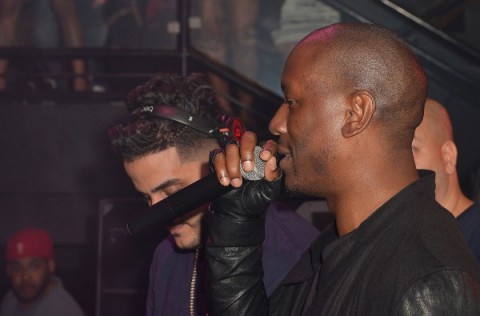
Tyrese Sends Bizarre Tweets Tyrese’s twitter account is always full of fun and surprises…and bad grammar. But he outdid himself at around 4 a.m. this morning. We don’t know if he was drunk or just horny or something. But he started tweeting about his feelings and wanting to be with a women. Then things got weird…click through to see his tweets about thinking about his kids while having sex! And how his followers spazzed out at him.
Wow, this is crazy and sad… Via NYPost “If you don’t get here fast, I’m going to kill this guy!” A distraught Queens teenager made that warning to a 911 operator moments before allegedly stabbing her brother to death in a clash over a cellphone, sources told The Post yesterday. Neighbors could hear screams from inside the first-floor Woodhaven apartment during a fight between Yocairis Diaz, 18, and Frank Fortuna, 20, at about 5:25 p.m. Friday. Fortuna picked up a dog chain and Diaz pulled a knife, a law-enforcement source said. The screams from the fight were soon replaced by cries of horror. “Help me, help me! He’s dying!” yelled their brother, Kelvin Diaz, 19, according to a neighbor who rushed to their aid. “Frankie was lying on the ground bleeding out, and his eyes were rolling back in his head,” the neighbor said. Yocairis called 911 again to report the stabbing, dialed a second number, then fled with a neighbor in tow. “I did it! I stabbed my brother,” she allegedly told the neighbor, who saw her a block from the murder scene. “You should have seen how he had me,” Yocairis allegedly added, making a strangling gesture. “I didn’t know what to do.” A black sedan with two women pulled up to the corner. Yocairis got inside and the car peeled out. She was arrested at about noon yesterday and hauled into Queens Criminal Court, where she was awaiting arraignment on a charge of second-degree murder, said District Attorney Richard Brown said. Fortuna was dead on arrival at Jamaica Hospital, police said. “He was a no-nonsense character, very serious guy,” sais McPherson 30. “I don’t know how to explain what happened. It’s sibling rivalry gone wrong.” Neighbor Kristina Anjarwati, 37, said, “You hear arguing all the time in this area. Nobody seems to get along. We are surrounded by it.” Wow, folks are really murking their family members over such petty bullisht. And now this girl will be in jail for a good portion of her adult life. SMH.
Kristen Stewart fans may have been disappointed that the Twilight superstar did not make an appearance at last week’s MTV Video Music Awards, but crowds here in Toronto had the chance to see the actress on the red carpet for the North American premiere of Walter Salles ‘ On The Road along with fellow cast members Garrett Hedlund , Kirsten Dunst , Amy Adams and Sam Riley . Stewart spoke with ML about the part she had actually landed before she filmed her first Twilight installment. Stewart shared her thoughts on the steamy relationship between her character Marylou and Hedlund’s Dean Moriarty — a life-long relationship that was rife with affairs, drugs and a wild ride on the road. [ PHOTOS: Kristen Stewart, Garrett Hedlund, and Kirsten Dunst at the Toronto premiere of On The Road ] “They really are ‘simpatico.’ It was a tumultuous relationship. And it’s hard to love like that, but they were so in love with each other and you don’t know this from reading the book, but they stayed lovers until the end of his life,” Stewart said during a conversation with ML at a Toronto hotel over the weekend. Stewart first read On The Road as a high school freshman. A short time afterward, she was approached by director Walter Salles who had been told to consider Stewart for the part of Marylou after fellow filmmakers saw her in Sean Penn’s Into The Wild and suggested that he consider the young actress. The project took a number of years before the actual shoot commenced and in the meantime, Stewart began doing the enormously popular Twilight series, propelling her fame into the stratosphere. “I got the [ On The Road ] job on the spot and I drove away vibrating,” Stewart said. In the film version of the book written by Jack Kerouac, Stewart plays the unconventional free-spirit Marylou, the former wife and still frequent lover of Dean Moriarty, a fast-talking charismatic with an insatiable libido. Dean and best friend Sal (Sam Riley), a young writer whose life is shaken after Dean’s arrival take to the road. Marylou frequently accompanies Sal and Dean’s travels across the country in adventures fueled by sex, drugs and the pursuit of the “It” – a quest for understanding and personal fulfillment. “He kind of raised her and she always had a place in his heart, even though there were a lot of spots in that heart, but she was definitely one in the center and the same goes the other way around,” Stewart said of Marylou and Dean, the On The Road names of the real-life individuals described by Kerouac. “They both helped each other grow up.” One of the seminal works of literature of post-war America, On The Road took decades to be made into a film, even after Francis Ford Coppola acquired the filmmaking rights to the story. Stewart said she believes that society may have not been ready to see On The Road in theaters in the immediate years after the book was published, acknowledging that the film, which has not yet been rated, is racy. “I think it’s a good time to see this story visually because we are not shocked by some of the things that we were so shocked by before and it would have veiled it,” said Stewart. “It would have been so shocking seeing people doing drugs and having sex that you wouldn’t have seen the spirit of [ On the Road ]. You wouldn’t have seen the message behind it. Maybe it would have been good because it would have forced people to look, but maybe they weren’t able to do it then.” She also expressed the need for young people to have dreams and a zest for life, similarly to the characters in the film, even if those dreams are not fully comprehended. “At that stage of your life there’s so much ahead of you, at least it feels that way. At that age you need to have a faith and feelings you can’t articulate yet because at some point you need to hold onto them and you’ll find the words to describe them.” [ Movieline will have more from our interviews with Kristen Stewart, Garrett Hedlund, and Walter Salles this week. ] Read more from the Toronto Film Festival. Follow Brian Brooks on Twitter . Follow Movieline on Twitter .
Call it the zen of Ryan. During a roundtable interview with Ryan Gosling and filmmaker Derek Cianfrance for their latest film, The Place Beyond The Pines , I asked the actor if he felt that the media focused too much on the more superficial aspects of his acting career — remember the hubub over Bradley Cooper being chosen over him as People magazine’s sexiest man of the year last fall? — when he keeps proving himself to be one of the finest actors working today. “I’m not really allowed to have an opinion so I just choose to not think about it,” Gosling said. “It is what it is.” After memorable performances last year in Drive , Ides of March and Crazy, Stupid Love , Gosling is riveting in The Place Beyond The Pines as a former stunt motorcyclist who turns to bank-robbing to support a son he fathered. Although the film has yet to secure a distributor, the buzz at the festival on Saturday night was that it was only a matter of time. During the roundtable interview — more of which we’ll post tomorrow — Gosling and Cianfrance, who previously worked together on the 2010 heartwrencher Blue Valentine , did not look like they were worried about their film reaching a wider audience. Asked what made the actor special, Cianfrance sounded mostly sincere when he called Gosling a “magic person who makes things better,” adding: “We’ve all seen him save people from getting hit by a car, and we’ve all seen him break up fights in the city. He makes the world a better place. And that’s what he does in a movie. He makes me a better filmmaker and everyone around him better.” In response to the same question, the deadpan Gosling replied: “I look like Derek.” Gosling declined to reveal the plot of his directorial debut, How to Catch A Monster , during the interview, but, elsewhere in Toronto, the star of his movie, Christina Hendricks was spilling the beans to Vulture . The actress said she portrays a single mother “supporting two children and trying to provide a home for them ” who finds herself working a “very surreal” fetish club “that gets me into a sort of predicament” while her two boys discover an underground city. Sounds like Fifty Shades of Grey meets City of Ember . Follow Frank DiGiacomo on Twitter. Follow Movieline on Twitter.
The night began with a little celebrity-fueled silliness. As Ryan Gosling arrived at the Princess of Wales Theater in Toronto for the premiere of his latest picture, The Place Beyond The Pines , a crowd of eager fans barged across traffic-stalled King Street to swarm the object of their affection. But once Gosling’s second film with filmmaker Derek Cianfrance — they made the remarkably pure heartbreaker Blue Valentine together — got started, it was clear that the two friends and a remarkable cast that included Bradley Cooper , Eva Mendes and Ben Mendelsohn had made a seriously good movie. [ GALLERY: The Place Beyond The Pines And More TIFF Films Likely To Succeed ] As Cianfrance told the crowd afterward, the movie “is about legacy — about being a father.” Gosling plays a stunt motorcyclist who turns to bank-robbing out of sense of responsibility to a child he fathered; his performance is so indelible that you don’t forget him once he’s left the screen. The remarkable thing is that Cianfrance — who said during the Q&A that the structure of the film was inspired by Psycho — gets Bradley Cooper, who plays a Schenectady, NY cop with adjustable morals, to pick up the baton and carry the movie before handing it off to Dane DeHaan and Emory Cohen, who both give memorable performances as the sons, respectively, of Gosling’s and Cooper’s characters. Indeed, there are so many strong performances in this movie — Mendelsohn is also a standout — that the Academy could have a tough time figuring out who to honor with a nomination. Cianfrance told the crowd that he actually began writing the film before Blue Valentine in 2007 when he was in the process of becoming a father for the second time. “I was thinking a lot about becoming a father again [and remembering that] I had a fire in me.” Sometimes, Cianfrance said, “it had helped” and “sometimes it destroyed things.” Thinking about the son he was expecting, the director said: “I didn’t want him to have the fire.” The Place Beyond The Pines is all about that fire and it leaves a searing impression, though there were some light moments during the Q&A. At the very end of the evening, after Gosling politely brushed off compliments about his sexiness and the tattoos he wears in the film, a woman in the balcony screamed, “Ryan I’m pregnant!” Follow Frank DiGiacomo on Twitter. Follow Movieline on Twitter.
The 2012 MTV Video Music Awards have come and gone, with Rihanna kissing Chris Brown ; Taylor Swift stage diving ; and One Direction taking home a trio of trophies. How did those in attendance react to the event? We’ve collected a series of Tweets and posted them below a montage of photos from the ceremony’s red carpet… Pink : “Had so much fun 2night Thanks MTV and VMA’s- thanks to all the lovely gorgeous fans/friends. And I’m out. Hello Europe! Here we come. XXX” Rihanna : #RihannaNavy we won Video of the Year!!! Thank you for voting! My night was major! Jah bless” Niall Horan : “Love you all soooo much! Guys what the hell! You are incredible, 3 vmas! We love u all soo much! All 3 of them are for u! Thank you!” Calvin Harris : “I won 2 moonmen! Great night! Away for my dinner 😀 #VMA. Thanks for all the congrats on the VMAs…had a great time + elated to leave with 2 little moonmen. Heading to Miami now, LIV tonight!!” Katy Perry : “Best art direction moon man is so hipster cool! YAY! #everyoneinsilverlakewildnout #peopleinsilverlakewouldntsaywildnout Demi Lovato : “Leaving VMAs…what an amazing night!!” Harry Styles : “We owe you everything. Thank you so much for this. Three VMAs!! YEAH .xx” Louis Tomlinson : “Wow can’t believe we won three awards ! I said it on stage but i’ll say it again! The awards are because of you guys , thank you everyone!” Lil Wayne : “Had a blast on stage! I thank all of my wonderful fans for the support!!!!! We ain’t s–t without ya!” Wiz Khalifa : “That Was Fun. Thnx For Da Love” Amber Rose : “Thx 4 all the Love my Rosebuds & Rosestuds I love u guys so much we’re about to have a lil #WizBud join our Rosebud fam Yay!! 🙂 I‘ve never been so happy.” Taylor Swift : “VMA dressing room report: exceptional snack selection. SCORE.” Nicki Minaj : “OHHHHHhhH MYYYYYY F–KINGGGGG GAHHHHHHHHH!!!!!!!!!!!!!!!!!!!!!! Barbz!!!!!!!!!!!!!!!!!!!!!!!!!!” Alicia Keys : “So thrilled I was finally able 2 share that w/ u @ the #vma! This is just the beginning! #girlonfire”
Rust and Bone is essential. It’s life and death. It’s like fucking at a funeral. It throws the grit of existence in your face and while you reel at our insubstantiality and balk at our crudity as human beings, it shows you that love is the only transcendent force we possess. What separates man from beast. There is no doubt it will polarize. There is nothing commercial here apart from the pulling power of Marion Cotillard . Cinematographically it is an expressionistic essay; intellectually, a two-hour conversation with its filmmaker. And physically it is a kick in the teeth, a depiction of poverty, sex and violence which crosses most known codes of acceptability. Spoilers follow. I would expect nothing less from director Jacques Audiard . From Read My Lips to The Beat My Heart Skipped to A Prophet , (the latter both also shot by Stephanie Fontaine) this is as ever courageous work. He is skilled at combining grainy realism with something esoteric — beyond romance. He creates criminal heroes within almost apocalyptic fairy tales. The premise of Rust and Bone is unbelievable — risible, even — and sounds more French farce than dramatic arc: A love story between a bare-knuckle street boxer and a woman who trains orca whales and loses her legs after a Seaworld accident. Adapted from a series of short stories by Craig Davidson, Ali (Matthias Schoenaerts), homeless and penniless with his five-year-old son Sam (Armand Cerdue) on his shoulders, turns up at his estranged sister’s in Antibes in the South of France. She houses them in her grimy garage, he gets a job as a bouncer in the local nightclub and rescues Stephanie (Cotillard), bloodied after a brawl. They don’t see each other again until after the accident; until after Stephanie has lost both legs to a killer whale. She calls him. He shows her no pity, and from there a relationship develops. As we move forward the stakes are raised and the scales turn. Audiard uses his common thematic – the juxtaposition of two characters, one the likeable criminal, the other the vulnerable — as Ali, involved in illegal street fighting and surveillance crime, compromises his relationships with Stephanie, his son and his sister. Simultaneously Stephanie begins to find her new identity and gets released back into her life, with or without him. Relative unknown Matthias Schoenaerts ( Bullhead ) is astonishing as Ali. He does nothing and everything, and, looking like a pit-bull, is at once a combination of unhealthy-yet-attractive and physically fit. And the bond between him and child actor Armand Cerdue is also extraordinary, almost symbiotic. This is also the best work I have seen Cotillard do. There are multiple moments in the film which are almost transcendent and indelibly stain the mind’s eye. Your heart leaps when Ali and Stephanie first have sex and you see that she has found renewed hope; a will to live, the will to return to work and confront her assailant. You feel empowered when you see her amputated legs resplendent with fresh tattoos (reading ‘Droite’ and ‘Gauche’). And you reel when she walks, prosthetic limbs on display, into the middle of a fistfight — possibly one of the coolest female character moments I have ever seen. It is all-physical. This is apt because Rust and Bone is corporeal. It tells you this in the opening shot sequence, when a montage of water and feet in sandals is accompanied by the overbearing sound of breathing and footsteps. The film is all about the body, about control and the loss of it. About the dichotomy between unwanted pain and pain sought — the accident and the bare knuckle boxing. The violence, the sex, is thus immediate and visceral. And whether you want to be or not, you are there — you can almost touch it, feel it, reach them with your hands. The fine lines between power and death are visible here too. The metaphors are clear; from the force of the whales leaping in and out of the water to the unseen dangers of ice and snow, we know that nature is bigger than us and in that terrifying reductivity there is love between father and son, man and woman. It is terribly intense, and French. There is no other way to describe it. And whereas I went out and bought the soundtrack (Bon Iver, Lykke Li, with score by Alexandre Desplat) and want to go back and see it again, the ferocity with which I liked it — was moved and haunted by it, and found it real and refreshing — could also be the ferocity with which it is loathed and eschewed for being pretentious and even sentimental. But like Audiard, Cotillard, Schoenaerts and I suspect everyone else who worked on the project, I’m happy to have that argument and suggest that this film is so good, it stands alone. This is not half-baked ennui — whatever anyone else thinks about it. Read more from the Toronto Film Festival. Follow Lorien Haynes on Twitter . Follow Movieline on Twitter .
Also in Friday’s Biz Break: indie horror maven Ti West goes “mainstream,” Daniel Craig signs for more Bonds, and Spike Lee ‘s Oldboy is snapped up by FilmDistrict for U.S. release. Jeffrey Wright Cast In The Hunger Games: Catching Fire Lionsgate continues to beef up its sequel cast with stellar veteran talent. The Tony- and Golden Globe-winning actor will play Beetee, a former victor from District 3 thrown into the Quarter Quell competition with Katniss Everdeen. [Press release] Robert Pattinson’s The Rover Makes International Sales The pic from David Michod ( Animal Kingdom ) sees RPattz teaming up with Guy Pearce for a gritty dystopian Outback thriller ; actor-filmmaker Joel Edgerton co-conceived the story, and filming begins this winter. Rights have been sold in “United Kingdom, Canada and Benelux to eOne, Scandinavia to Nordisk, Latin America to Sun Distribution, the Middle East to Italia Film and Eastern Europe excluding Russia to Revolutionary Releasing. Village Roadshow already picked up the film in Australia and New Zealand,” per THR . Ti West And Eli Roth Team Up For The Sacrament Indie horror auteur West ( House of the Devil , The Innkeepers , V/H/S ) begins filming this month on the under-wraps horror thriller, which will court buyers at the Toronto Film Festival. Roth will produce and West will direct from his own script in what Roth describes will be West’s “first mainstream movie,” via Variety . Daniel Craig Commits To Two More Bonds With his third turn as 007 in the can ( Skyfall hits theaters in November), Daniel Craig has signed up for at least two more Bond pics in the current EON Production series. According to MI6 , Sony/MGM execs are aiming for an aggressive two year gap between films. Spike Lee’s Oldboy Gets U.S. Distribution He hasn’t even begun filming yet (though he told Movieline he’ll definitely shoot on celluloid ), but Spike Lee continues to put his ducks in a row for his Oldboy remake. FilmDistrict will take U.S. rights as Lee heads into production this month, according to THR . Follow Jen Yamato on Twitter . Follow Movieline on Twitter .
Keep The Lights On director Ira Sachs ( Forty Shades of Blue , Delta ) tapped into his own experience in a tumultuous relationship that would eventually morph into the film that screened to accolades at the Sundance and Berlin film festivals earlier this year, winning the New York-based filmmaker a Teddy Award at the Berlinale. Keep The Lights On morphed out of the disintegration of a relationship he had with a man that spanned a number of years in New York around the turn of the century. Career demands, extra-relationship temptations, addictions, obsessions and more play into the rocky road experienced by the young couple. Sachs took inspiration for Keep The Lights On from the likes of Lisa Cholodenko’s The Kids Are All Right , Bill Sherwood’s Parting Glances and Jacques Nolot’s confessional Before I Forget , constructing Keep The Lights On as a gay man in NYC while embracing at times details some may consider unflattering. Danish actor Thure Lindhardt plays documentary filmmaker Erik, while American Zachary Booth plays closeted lawyer Paul, a couple who embrace each other while passionately forming a dramatic relationship rife with sex, drugs, highs, lows and dysfunction. Ahead of Keep The Lights On ‘s theatrical release this weekend, Ira Sachs invited Movieline over to his NYC apartment, which, perhaps not so coincidentally served as a prime location for his film. He talks about embracing depictions of addiction and sexuality, the challenges of making indie film today, how making the film affected him personally and what his former partner, who helped inspire the project, thought of the film. When did you decide that you actually wanted to make this film? I saw a film called Before I Forget by Jacques Nolot at (New York’s) Cinema Village, which was programmed by Ed Arentz — who is now my distributor. And what I saw [was] a film that reflected sort of contemporary life — Parisian life — of a filmmaker who was gay, but also what his life in Paris is that looks like something specific. As a gay person how we live looks very specific today and different than it did 20 years ago. I felt like there was no film that looked like my life, and no film which really reflected the community that I live in which is very mixed. The boundaries between gay and straight, I think, for most of us in our everyday lives, though not in our psyche has dissipated. So I wanted to make a film about sort of what I had seen in the last many years here. But specifically I ended a relationship in 2008 and I had a sense that 10 years before that was an interesting story. I started writing and I put it away for a couple of years, and it was really Mauricio Zacharias, my co-writer who read that material and said, “Well clearly this is a story you have to tell.” And in a way because I was doing something so autobiographical, I think I needed someone else to give me the blessing that it would be relevant. So how much of it is similar and how much of it is a departure to your own life during a certain time period? We began with the journals, and diaries, so we began with the raw materials from my life, but then ultimately we were creating a screenplay, which is constructed around its own laws and orders. And in a way, all my films have begun with things that I feel like I know more than anyone else. They’ve begun in a very intimate place. So you’re creating it similarly to the approach you took in Forty Shades of Blue for instance? Forty Shades was kind of about my dad actually. I grew up in Memphis with this larger than life figure who always had these younger girlfriends. And my relationship to those girlfriends was my entry to the film, and that sort of thing. And then when you start making a movie [like Keep the Lights On ] and you’ve cast a Danish actor to play a character based on yourself, then you’re like off to the races because you’re making a film. So what made you decide to go that route with a Danish actor? Was it that the actor Thure Lindhardt personally that appealed to you? I sent the screenplay to an agent that I have worked with in Hollywood, and I got the response that no one in the agency would be available for this [project]. And I knew even before that I wanted to make this film different. I thought that this film needed to be a truly independent film, so it would be financed that way. It would be made that way. So I heard about Thure who I was told was the bravest actor In Denmark and one of the best, and I knew that he would be. I sent him the script and he was alone in a hotel room in Spain, and he ended up using up all the scenes one could shoot alone, which were a series of masturbation scenes. And I knew that he was both comfortable with the material, but also really amazingly interesting to watch. So I casted him. Is this a little reflection, perhaps, on American actors, that they’re less inclined to do this sort of thing? I have a Danish lead actor. I have a Greek cinematographer. I have a Brazilian co-writer. I have a Brazilian editor. I had a Romanian script supervisor. I surrounded myself with non-American sort of sensibilities. And I think that’s a big part of the film. It’s a film about New York, and it’s a very New York film, but I think it’s told in a way that’s not repressed, and it doesn’t look at sex as some foreign object that has to be viewed only in the dark. Do you agree that that’s sort of the American POV generally, that violence in movies is acceptable, but sex is taboo? I do, I do. I think when this film played in Berlin, it was the most ordinary movie you could see.It was extremely ordinary which is very different than how it played at Sundance. How did it play at Sundance then? The subject matter and the sexuality made people uncomfortable. I think there’s a fear of difference in American cinema. And I was thinking a lot about that when I made this film because there used to be an idea that independent cinema was independent cinema . And that production and the means of production were actually separate from commercial cinema. And that gave you certain rights and opportunities — and I had all those rights and opportunities. I am one of a number of filmmakers who started out making films about gay people who stopped. My whole generation, most of us stopped. We either couldn’t make films, or we had to make other kinds of films. And I think that that’s partially about the individual, but it’s mostly about the culture, and trying to figure out how to sustain a career. I think for me, ultimately, I feel now that in some ways my marginal voice is actually my most powerful. It’s also possibly economically my most fertile, because I’m the guy who can make these films. Is there still a pretty low glass ceiling for gay filmmakers generally in this country? It wasn’t any easier to make a film about a Russian woman living in Memphis ( Forty Shades of Blue ). When you’re trying to make non-broad character-driven stories, and I’m interested in documentary as forum, so I’m actually trying to get the details right, which makes it even more specific in a certain way. Going back to Keep the Lights On and Thure’s character Erik, I got the feeling he was a little bit a love junkie. Yeah, and I would agree. He was someone who didn’t feel complete without obsessing over something. I think, no one’s used that term, but I think it’s a good one. It’s better than a sex addict. I mean, I like love junkie… He is someone who just emotionally needs some attachment. I think that there’s a compulsive need to be connected to another person. And I think the film in a lot of ways is less about addiction and more about obsession. There was something, these two guys, both of them are obsessed with the idea of maintaining their life together. And I think with obsession, sometimes it seems like the most comfortable place to be, because it shuts out everything else because you think, “Well if I can control this situation, then I can control my life.” So was it emotional reliving this to a degree? It wasn’t. No? It wasn’t really. I mean, I think by the time that I made the film I really believe I’d done all the therapeutic work and transformation in a lot of ways. Occasionally it felt like déjà vu. It was like an odd sensation that occasionally I was creating fictional scenes that were replicating things that were close to my own life. But mostly I just really felt like my life was one of the drawers that we can open. And I was always very willing to share as much as I could with the actors. But I never felt like they needed to try to do anything other than what was natural to them as actors and as people living the story. I mean, a lot of what I think I do as a director is try to give everything over to the actor. So I disappear. I mean, but the helms are their helms. The spaces are their spaces. I don’t rehearse with my actors. Then what’s your methodology of instruction? I talk to them individually, but I never talk to them together. So really in a certain way it’s more difficult for the actor because there’s a lot of risk, but actually that risk I think is the element that you could actually name in the performance in this film, and in my films in general. I think there’s something risky about it all. This is the moment. So I think to trying to capture the moment means that you’re really valuing the present, which includes the past, but it is about the present which is about the actors, it’s about flirtation, it’s what happens between them. Did you ever consider not emphasizing the drug use? Maybe there would be some other more acceptable vice like — alcoholism? An everyday addiction… Yeah, an everyday addiction, a “legal” addiction, yeah. You know, I really wanted to be unashamed and unabashed about the truth of my relationship and my behavior, and to not shy away from the details, and to not judge the action. So pot-head, crack addict, different kinds of distractions, different kinds of consequences, but the root of addiction is usually similar in lots of ways. And I feel like the drug use that the film talks about is really prevalent in the gay community at least. It’s something I feel like goes unspoken. So has your former partner seen this film? Yeah, he has seen the film. I showed him the film before Sundance. And he’s been very supportive. I mean, I think it’s not him. It’s a story about our relationship as seen through my eyes. Next: The New York filmmaker gives his personal Top 9 NYC films
Note to MMA fighters (and everyone about to throw down in any situation): Only taunt your adversary if you’re ready for the kick to the face you might provoke. While Shai Lindsey certainly livened up his MMA bout with Carlo Juinio in the Tuff ‘n’ Uff amateur arena Sunday, he proved that showboating is a double-edged sword. After raising his arms in a “Come at me, bro,” gesture of sorts, Juinio did as he requested, LEVELING Lindsey with an abrupt kick to the face , ending the match. Fortunately, he suffered only a massive hemorrhage to his ego.