Tag Archives: major newspapers

Deceive the Children: NYT ‘Learning Network’ Frames Federal Income Tax Rate Extension as Benefiting ‘Especially the Wealthy’

A New York Times “Learning Network” graphic informs us that under the proposed Obama-GOP tax and spending compromise, “rates will not change for at least two years for anyone.” Wow. Somebody at the Learning Network needs to tell the Old Gray Lady's beat reporters, editorial board, and opinion columnists. Just today, reporter Helene Cooper, in noting

Tribune’s Matea Gold: Jon Stewart Rally ‘Could Draw Tens of Thousands’

Just two days before Glenn Beck’s August 28 “Restoring Honor” rally, the Washington Post published an article about how the rally would “be a measure of the tea party’s strength.” “When Fox News and talk radio host Glenn Beck comes to Washington this weekend to headline a rally intended to ‘restore honor’ to America, he will test the strength – and potentially expose the weaknesses – of a conservative grass-roots movement that remains an unpredictable force in the country’s politics,” staffer Amy Gardner argued in the opening paragraph of her August 26 story. Gardner’s article is but one example of the media’s skeptical attitude prior to the Beck rally. Yet just days after two Comedy Central hosts announced mock rallies for October 30 on the Mall, the liberal media are expecting that Jon Stewart and Stephen Colbert can easily draw a large crowd.  I noted the breathless anticipation of Newsweek’s Daniel Stone last Friday . Now it seems that Matea Gold of the Washington bureau of the Tribune Company is also decidedly optimistic. In her 13-paragraph article, accessible at LATimes.com , Gold quoted a few folks who plan on attending and took the Facebook RSVPs on face value as a signal about potential attendance: As of Wednesday afternoon, more than 132,000 people planned to attend, according to the event’s Facebook page, while satellite rallies were being organized in Chicago, Seattle, Austin and other cities. Nowhere in her article did Gold give ink to any skeptic who would rain on the Comedy Central parade by suggesting the initial “hey, that sounds cool” interest by Stewart/Colbert fans would fail to flesh out into actual attendance after they consider the cost and hassle of attending the event.

Read more:
Tribune’s Matea Gold: Jon Stewart Rally ‘Could Draw Tens of Thousands’

At NYT, Kate Zernike’s Clueless Advice to GOP Candidates: ‘Enlist (Tea Partiers), but Avoid Speeches on the Constitution’

It’s almost tempting to just run a few paragraphs of Kate Zernike’s latest item in the New York Times and simply have folks take their rips, but a bit of background would be helpful. Zernike (pictured at right) is the Times reporter who seems to have made it her mission to somehow singlehandedly discredit what may when all is said and done come to be seen as the most significant grass-roots movement in America in a long, long time. Earlier today, Clay Waters at NewsBusters reviewed Zernike’s new book, “Boiling Mad — Inside Tea Party America,” noted that she “evinces little sympathy or feel for conservative concerns,” and is intent on “finding racism everywhere she looks in Tea Party land.” In a late March post (at NewsBusters ; BizzyBlog ), I noted a Zernike item (“With No Jobs, Plenty of Time for Tea Party”) which cynically questioned “whether the movement can survive an improvement in the economy, with people trading protest signs for paychecks.” This is the same Kate Zernike  Andrew Breitbart memorably called “a despicable human being” after she claimed to have found racism that really didn’t exist at CPAC in February. With that background, the paragraphs that follow from Kate’s latest calamity won’t surprise anyone too much, but they will as usual disappoint if you’re foolishly expecting anything resembling fair treatment (bold as mine): So you’re a Republican candidate and you want to take advantage of the Tea Party energy that jolted once-sleepy primaries. But you aren’t sure whether that means you have to take a stand against masturbation or urge your supporters to gather their bayonets — tactics that seem to have worked for a few Tea Party candidates so far. You’re not certain most Americans share the Tea Party enthusiasm for repealing the 17th Amendment (or even know that it established direct election of United States senators by popular vote). You don’t have Sarah Palin’s phone number. Not to worry. There’s no doubt that the Tea Party is a double-edged sword: a New York Times/CBS poll last week found that while most Americans had not formed a view of the Tea Party, the percentage of independent voters who view it negatively had increased. But the Tea Party has brought a swell of new participants to the political process, and historical and economic trends are working in favor of the party out of power — that would be you, G.O.P. The trick is to take advantage of the Tea Party passion and stay away from its extremes. Celebrate the genius of the Constitution, but don’t get into the particulars. Tea Party activists, Republican moderates and independent handicappers all agree that the road for Republican candidates is to talk about the debt and concerns about the new health care legislation — areas where Tea Party sentiment is more aligned with the views of most Americans. … Tea Party activists — and their candidates — pose a problem when they move the discussion into a broader one about the role of government. “You see these rallies and the signs are all about the Constitution,” said Stuart Rothenberg, editor of a nonpartisan political report. “They want it to be about these big ideological ideas, when I don’t think most voters think that way. It’s very clear that what’s best for the election is to make it about Obama, Pelosi, health care, the deficit.” Rothenberg is about as “nonpartisan” as Larry Sabato , i.e., give me a break. He also doesn’t get it if he really thinks that enough voters to matter aren’t worried about the Constitution and how its limits on Executive Branch perogatives are being ignored. You’ll note that Zernike didn’t quote a bona fide Tea Party member about her novel suggestion to “not get into the particulars” of the Constitution. Zernike? The arrogant condescension continues. Remember in November. Cross-posted at BizzyBlog.com .

Read the original post:
At NYT, Kate Zernike’s Clueless Advice to GOP Candidates: ‘Enlist (Tea Partiers), but Avoid Speeches on the Constitution’

ABC’s George Stephanopoulos: Will GOP Landslide Be a ‘Blessing in Disguise’ for Obama?

Good Morning America’s George Stephanopoulos on Tuesday tried to find the upside to a possible Democratic landslide in November. Talking to Fox News host Bill O’Reilly, he wondered if major Republican gains could be ” a blessing in disguise for President Obama. ” [Audio available here .] Stephanopoulos touted the historical model of Bill Clinton losing the Congress in 1994, but being reelected in 1996.The host, who was a senior advisor to Clinton when the Republicans won the Senate and House in 1994, didn’t seem very happy at the time. In his book, All Too Human, he recounted with gloom: ” Our nemesis Newt Gingrich was now Speaker– two heartbeats from the White House. If Clinton really were a prime minister, he’d have been out of a job. ” [Page 322. Emphasis added] O’Reilly dismissed the comparison: “It’s a different world…Bill Clinton was like Martin Van Buren, I mean, as far as the media’s concerned. This is a hyper medium. Everything is blown up the second it happens on the internet and cable.” At one point during the interview, O’Reilly derided the President’s plan to let tax cuts for upper income groups expire as “class warfare.” He pressed the ABC host, “Would you agree with that?” The ABC journalist unsurprisingly quipped, “Not necessarily.” After O’Reilly described a tax rate of 40 percent as too high, the argumentative Stephanopoulos asserted, “That’s what the rates were under Reagan and people did pretty well.” (Of course, the top marginal tax rates under Reagan were actually going down, a point Stephanopoulos ignored.) A transcript of the September 14 segment, which aired at 7:08am EDT, follows: GEORGE STEPHANOPOULOS: For more now, we’re joined live by the host of The O’Reilly Factor on Fox News, Bill O’Reilly. Also has a brand new book: Pinheads and Patriots: Where You Stand in the Age of Obama. Welcome back. BILL O’REILLY: Hey, George. How are you? STEPHANOPOULOS: I’m doing great. Thank you. O’REILLY: George never looks tired in the morning. Can you get a close-up of George? STEPHANOPOULOS: Not too close. O’REILLY: Eight o’clock at night. Here’s George. STEPHANOPOULOS: Well, you’re my bedtime TV watching. I go to bed early. O’REILLY: I appreciate that. STEPHANOPOULOS: I want to talk about the book. Let’s get into the tax fight first. Because, I was struck by the Wall Street Journal this morning. They think that John Boehner, the Republican leader made a big bungle on Sunday when he said he would vote for the extension of middle-class tax cuts, even if all the tax cuts weren’t extended. O’REILLY: Well, I think he was caught in the tanning bed in the salon and he didn’t really hear what was going on. Look, the whole thing is class warfare. Would you agree with that? I mean- STEPHANOPOULOS: Not necessarily. But, go ahead. O’REILLY: No? But, really though, what the President is selling is he’s saying the upper tier are going to have to be responsible for the tax revenue, primarily. And the other people will get a tax cut. He’s saying, “Look. I don’t care about these people, who earn a lot of money. But, you know, I want to help you.” I think that’s class warfare. STEPHANOPOULOS: He’s saying we can’t afford it. He’s saying there’s $700 billion in costs there that we can’t afford. That’s his argument. O’REILLY: Yeah. And who imposed those costs? STEPHANOPOULOS: Who did? O’REILLY: George? He did. So, you know, look. I think 35 percent to the government is a fair deal. I think it is. And then, if you get over 40, which is where he wants to put it, that’s kind of punishing people. So, I don’t buy the tax cuts for the rich. STEPHANOPOULOS: No. That’s what the rates were under Reagan and people did pretty well . O’REILLY: Look, I don’t care whether it was under Reagan or George Washington. All right? I work hard for my money. Do I want to fork over 40 percent over to the feds and then pay property taxes and sales taxes and every other tax in the world? Come on. STEPHANOPOULOS: What do you think is going to happen? O’REILLY: I don’t know. You know, look, it’s going to be another brawl. Republicans will stretch it out just because they want to create, the Republicans do, an image of chaos for November. They want to say that President Obama just can’t govern. That’s what the end game is. STEPHANOPOULOS: How about these midterm elections? We’re seeing, a lot of these states, the Tea Party on the rise, on offense again. You write about the Tea Party in your book. You say- unfortunately, I hope we can put it up right now- “Unfortunately, some Tea Party people play into the bogus far-right stereotype by demonizing President Obama in crude ways. I admire what the President has accomplished in his life. Please, don’t tell Rush Limbaugh. And how he overcame a childhood that could have ruined him.” So, do you think on balance the Tea Party has been a net plus or a minus? O’REILLY: Well, there’s two separations. I say in Pinheads and Patriots that the Tea Party, primarily, patriots because they tell people what they believe and get involved. That’s patriotic. I don’t care, really, what your ideology is. If you’re out there, and you’re sincere and telling people this is the way I’m see my country and I want to improve it, you’re a patriot. Whether, you’re a liberal, a Tea Party person, whatever. Okay? However, if the Tea Party people basically attack President Obama personally, that diminishes their movement. STEPHANOPOULOS: You say, stick to policy. O’REILLY: If they say he’s a Muslim. If they say he was born in, where, Indonesia. This really hurts their overall message of “Get off our back.” The Tea Party message is “Get off our back.” That’s a good message. I mean, I don’t want the feds on my back. I don’t want them in my living room, George. STEPHANOPOULOS: That message has toppled some Republican establishment candidates. Bob Bennett. O’REILLY: Who are deemed to be wishy washy on that. Look, the tea party is a simple movement. They want local control. They want the feds not to have as much power. Whereas, President Obama wants this huge federal apparatus. That’s a good debate. STEPHANOPOULOS: Bottom line, do you think Republicans are going to take control of Congress? And if they do, is that a blessing in disguise for President Obama? O’REILLY: I have no idea. I don’t really do the party politics thing. Morris over- Dick Morris. He thinks they will. But he’s got, you know, he’s rooting for them. But I’ll tell you what. President Obama has got a leadership problem right now. He has got a leadership problem. If he gets whacked, if he loses the House, that’s going to get worse. This is a huge election for President Obama himself. He has a leadership problem. STEPHANOPOULOS: So, you think if he loses, that spells trouble for him in 2012? O’REILLY: Of course. STEPHANOPOULOS: Not the opposite, where for Bill Clinton lost in ’94, the Congress, it actually helped him. O’REILLY: It’s a different world. It’s a hyper world now. Bill Clinton was like Martin Van Buren, I mean, as far as the media’s concerned. This is a hyper medium. Everything is blown up the second it happens on the internet and cable. So, it’s no longer those rules. And the perception gets out there much quicker than it did. STEPHANOPOULOS: You know, you’ve been weighing in on the controversy over the Islamic center sown at Ground Zero. I was struck yesterday that the imam, Imam Rauf, went to the Council on Foreign Relations, seemed to back off a bit. Said that all options are open. He may even consider moving it. O’REILLY: Did you see the Factor’s exclusive last night? STEPHANOPOULOS: I did. O’REILLY: Rauf is now tied in with this Kahn who is a Truther. STEPHANOPOULOS: But, there’s no evidence that Rauf believes anything like that. O’REILLY: It doesn’t matter. It’s his pal! His pal! STEPHANOPOULOS: They served on a board together. O’REILLY: He’s formed the Muslim organization with him. And the guy, Khan, has been talking down at the Burlington Coat Factory building. I don’t know whether he got a free suit. But, this guy, Khan, says that al Qaeda didn’t do it. And Rauf goes in and says I’m a man of peace. He may be. But who are you hanging around with? And then when we asked Rauf for a comment, he runs and hides. STEPHANOPOULOS: We’re going to talk to him as well at some point.

Originally posted here:
ABC’s George Stephanopoulos: Will GOP Landslide Be a ‘Blessing in Disguise’ for Obama?

Brooks: ‘Tragedy’ If Republicans Reject More Government, Higher Taxes

If a RINO is a Republican In Name Only, let’s coin a new acronym for David Brooks: RINYTO: Republican In New York Times Only.  For only in the Gray Lady’s bailiwick could Brooks be considered much of a Republican. Take his current column in the Times.  Brooks warns Republicans on the verge of regaining power that it would be nothing short of a “tragedy” if they were to oppose . . . more government and higher taxes. Excerpt [emphasis added]: If the current Republican Party regards every new bit of government action as a step on the road to serfdom , then the party will be taking this long, mainstream American tradition and exiling it from the G.O.P. That will be a political tragedy. There are millions of voters who, while alarmed by the Democrats’ lavish spending, still look to government to play some positive role. They fled the G.O.P. after the government shutdown of 1995, and they would do so again. It would be a fiscal tragedy. Over the next decade there will have to be spending cuts and tax increases. If Republicans decide that even the smallest tax increases put us on the road to serfdom , then there will never be a deal, and the country will careen toward bankruptcy. Brooks apparently believes we don’t have enough government and that taxes are too low.  I’d say that makes him a Republican only in the rarefied air of 8th Ave. between 40th & 41st streets.

See the original post:
Brooks: ‘Tragedy’ If Republicans Reject More Government, Higher Taxes

Bad News Out of GM Is Not News at AP

The news out of Government/General Motors during the past couple of days hasn’t been particularly good. First, August sales results were disappointing. Second, it become known today that GM will attempt to go public on November 18, a later than originally hoped post-election date chosen to hopefully allow for another reported quarterly profit to boost investors’ appetite for its shares. As so often has been the case during Democratic administrations when unfavorable developments arise, the UK press has seen potential problems with the IPO, while the Associated Press has been acting as if all is well. In two separate items, AP reporters couldn’t even bring themselves to tell readers what the company’s real August sales decline was. In a report yesterday on the industry’s awful August, reporters Dee-Ann Durbin and Tom Krisher were appropriately gloomy overall, but they massaged GM’s reported result (bolds are mine throughout this post): Americans nervous about the drumbeat of bad economic news stayed away from auto showrooms. Automakers nervous about their bottom lines didn’t offer deals to lure them in. As a result, it was the worst August for U.S. auto sales since 1983, when the country was at the end of a double-dip recession. General Motors, Toyota, Honda and Ford all reported declines from the month before and from a year earlier. The bleak results were a reminder that, for all the good news about the turnaround of the Detroit automakers, the market for cars and trucks in the United States remains frail. Initial data showed sales came in at about 997,000, down 5 percent from July, according to AutoData Corp. “Coming in below a million units is eye-opening for August,” said Paul Ballew, a former chief economist for GM. “I never thought I’d see that. That’s a tepid month for August, which is supposed to be one of the top months of the year.” … “We know it’s going to be a modest recovery. It’s going to be bumpy,” said Don Johnson, GM’s vice president of U.S. sales. “What we don’t want to do is get back to putting incentives in the marketplace to keep the plants running.” … Overall, sales at Ford were down 5 percent from July and 11 percent from last August. At GM, sales of its four remaining brands were down 7 percent from a month ago and 11 percent from a year ago. For the year so far, sales are up 5 percent at GM, which is preparing for an initial public offering of its stock that could come as early as next month. We learned today that the “next month” part concerning the IPO isn’t going to happen. In her report today , Durbin’s massage was more thorough: Analyst: GM plans to sell shares on Nov. 18 General Motors plans to start trading shares again on Nov. 18, timing that allows the company one more quarter of earnings to build its case to investors, a firm that researches initial public offerings said Thursday. Scott Sweet, the managing partner of IPO Boutique, said GM plans to price the shares on Nov. 17 and begin selling them the next day. He said the automaker wants to start a two-week a road show to drum up investor interest on Nov. 3, the day after the midterm congressional elections. It’s unclear if the IPO dates have been finalized. Two people with knowledge of the process say the automaker’s board hasn’t approved a date for the IPO but is expected to meet next week to discuss the issue. GM is in a “quiet period” before an IPO, so no one is authorized to discuss the process publicly. … Sweet said his information comes from multiple people on Wall Street but declined to name them. He says the company hasn’t yet established a price for the shares, but hopes to raise $15 to $20 billion with the initial public offering. The timing could disappoint some Democrats who supported the government’s $50 billion bailout of GM last year and wanted to point to a successful IPO before the elections. … But one more quarter of earnings could help the automaker establish that it is healthy and capable of making sustained profits. GM earned $2.2 billion in the first half of 2010 despite depressed U.S. auto sales, but it lost $3.4 billion in the fourth quarter of last year. GM also hopes the U.S. auto market sees some modest improvement this fall. On Wednesday it said its U.S. sales fell 5 percent from July and 11 percent from last August, when they were boosted by the Cash for Clunkers program. The fact is, as seen in this Wall Street Journal compilation , that GM’s August 2010 sales were 24.5% lower than August 2009. For Dee-Ann Durbin’s and Tom Krisher’s benefit, that’s the result you get when you go to the WSJ link and compare the 185,105 vehicles sold in August 2010 to the 245,066 sold in 2009, and divide the difference (59,961) by 245,066. Yes, according to the company , sales of the company’s four remaining brands were down “only” 11% from a year ago. But it’s your job to report the full story, not merely to parrot the company’s press release. The folks at the Financial Times understand that, and also see how a company reporting declining sales in its largest market might encounter a bit of difficulty foisting its shares on the investing public. Reporter Bernard Simon also managed to find space for the actual year-over-year sales decline in yesterday’s coverage (link requires free registration): GM Sales Dip Casts Shadow Over IPO General Motors’ sales in its core US market sagged in August, potentially complicating its bid to drum up investor support for its forthcoming public share issue. Sales were a quarter lower than in August 2009 , when demand was bolstered by the Obama administration’s cash-for-clunkers scrappage incentives. GM has also eliminated four brands since then. More worrying, however, was a 7.2 per cent decline from July. Low-margin sales to car rental operators and other fleet owners climbed to 28 per cent of the total, from 25 per cent in July. “August was definitely what we call ‘one of those months’,” said Don Johnson, GM’s head of US sales operations. Mr Johnson said that consumers remained cautious amid an unexpectedly slow revival in employment. In the longer term, however, he forecast that there was “pent-up demand building” that would “eventually be released when the economy gets a firmer footing”. … GM filed a bulky draft prospectus for an initial public offering with US and Canadian regulators last month. The US and Canadian governments hold 72 per cent of GM’s equity. The document warns that in spite of a pick-up in demand since late last year, “many of the economic and market conditions that drove the [earlier] drop in vehicle sales, including declines in real estate and equity values, increases in unemployment, tightened credit markets, depressed consumer confidence and weak housing markets, continue to impact sales”. If the recent revival falters, the prospectus warns, “our results of operations and financial condition will be materially adversely affected”. It’s hard to fault Mr. Johnson for his optimism, but if he thinks the revival in employment has been “unexpectedly slow,” he’s been reading too many happy-talk missives from Team Obama. Durbin at the AP and an unbylined Reuters article both report that GM will conduct its IPO “road show” during the two weeks after the November elections. Reuters says that “The final value of the IPO has not been set but one source said early plans for the IPO envisioned selling $12 billion to $16 billion in common stock and $3 billion to $4 billion in preferred stock that would convert to common stock under a mandatory provision.” That’s $15-$20 billion of the $50 billion (really more) the government “invested” in return for a 61% stake during the company’s emergence from bankruptcy. Even if the IPO flies, it will still be Government Motors. Both Reuters and the New York Times correctly noted GMs 25% year-over-year August sale decline. Since AP couldn’t bring itself to do so, the graphic at the top right of this post, which may have seemed a bit over-the-top when it appeared a few weeks ago, is more appropriate than ever. Cross-posted at BizzyBlog.com .

See the original post:
Bad News Out of GM Is Not News at AP

‘Ground Zero’ or ‘ground zero’? AP, NYT Long Ago Opted for Lower Case

File this under “Fascinating Things You Learn When Researching Other Things.” The Associated Press’s infamous memo huffing and puffing about how it will henceforth describe the 13-story mosque/community center/kumbaya center that Imam Feisal Abdul Rauf would like to have built on a site two blocks away from where the World Trade Center Towers once stood opened with this sentence: We should continue to avoid the phrase “ground zero mosque” or “mosque at ground zero” on all platforms. Obviously the publicly announced editorial decision was news, but how about the lack of uppercase letters in “Ground Zero”? It turns out that both the AP and the New York Times routinely do not capitalize “Ground Zero,” making them grammar outliers. Here was one grammarian’s take on the matter in 2007 (bolded in final sentence is mine): Today’s topic is capitalizing tricky nouns like Ground Zero, Internet, and Earth. Ground Zero Since we’re coming up on September 11th, I was thinking about Ground Zero, and I realized that sometimes I see the words ground zero capitalized and sometimes I don’t. Back in 2001, it seemed as if the name Ground Zero got assigned to the site of the World Trade Center in New York almost immediately. Traditionally, ground zero means the site of a nuclear explosion, and sometimes it is used to refer to the site of a more general explosion or an area where rapid change has taken place. In those general instances, ground zero would be a common noun and wouldn’t be capitalized. On the other hand, although there are a few dissenters, most notably the New York Times, most people agree that Ground Zero is the name of the specific site of the former World Trade Center, and therefore it’s a proper noun that needs to be capitalized when it is used in that way . Besides the Times, the AP is not in the grammarian’s roster of “most people” who correctly capitalize “Ground Zero” as a specific place in Lower Manhattan. Perhaps they would prefer to be described at “the nyt and the ap.” This past Monday, referring back to something he wrote in 2002, the guy who runs TestyCopyEditors.com remined readers he doesn’t like the use of the term “Ground Zero” in uppercase or lowercase: “Ground zero” has a long history as a cliché but was occasionally useful in its original sense, meaning the point at which a nuclear explosion is triggered. To apply the term to the World Trade Center is to be needlessly vague about the nature of the attack. It also makes the term useless in its original sense, particularly in reference to the nuclear attacks on Hiroshima and Ngasaki, Japan, in 1945. That’s interesting. Maybe the term’s use first became popular in the establishment press once it was coined as a convenient shortcut to avoid using the the “T-word,” as in “the site of the 9/11 terrorist attacks,” or even to describe what occurred as “attacks” at all. If it was a strategy, it didn’t work out particularly well. Virtually everyone knows that “Ground Zero” in a story about New York City is where the terrorist attacks occurred. Here is a collection of current raw headlines found at the wire service’s main site at 5:20 p.m. in a search on “Ground Zero” (not in quotes, but capitalized): I count eight headlined instances of lowercase use of Ground Zero (the AP uses sentence case for its headlines). With the exception of one link to a multimedia item (“Plans for Ground Zero”) and links to two videos (“Obama backs mosque near Ground Zero” and “Obama Supports ‘right’ for Ground Zero Mosque”), “Ground Zero” is in lowercase format at all relevant underlying AP items listed above. So determined is the AP to keep “Ground Zero” in lowercase format that it revised the words in two paragraphs it directly quoted from a Rochester New Democrat and Chronicle editorial . The relevant paragraphs originally read as follows: The controversy over building a community center and mosque near Ground Zero cuts so deeply to the core of this country’s founding that President Barack Obama was right to weigh in. … That’s the rub. Many Americans view Ground Zero as hallowed ground, and building a mosque nearby seems beyond insensitive. In a roundup of editorials on various topics, the AP de-capitalized both uses of the term. This after-the-fact revision of another publication’s work seems to reflect a grim resolve that goes beyond the normal policing of grammar. If so, what’s the source? You’ll have to excuse me for believing that business arrangements similar to those  described here four years ago might have influenced the AP’s original decision-making process: Arab states have for decades paid substantial sums for control over content and other news-management privileges that I daresay would be refused at any price (with the mere request being treated as an earth-shaking scandal) if asked for by representatives of any Western country. Say it ain’t so, AP. Cross-posted at BizzyBlog.com .

See the original post:
‘Ground Zero’ or ‘ground zero’? AP, NYT Long Ago Opted for Lower Case

Report: Shirley Sherrod to Meet with Vilsack on Tuesday; Will the Press Raise Worker Exploitation Charges?

The Theater of the Sherrod(s) is apparently not over. At AL.com last night, Mike Tomberlin of the Birmingham News reported the following : Former USDA employee Shirley Sherrod says she will meet Tuesday with agriculture secretary Shirley Sherrod, the former USDA rural development director for Georgia, said today she plans to meet Tuesday with U.S. Secretary of Agriculture Tom Vilsack to discuss a new job offer. … Sherrod today spoke in the Sumter County town of Epes at an event hosted by the Southern Cooperatives/Land Assistance Fund. Ben Jealous, executive director of the NAACP, shared the stage with Sherrod during a panel discussion. Sherrod said she had no ill feelings toward the NAACP or President Barack Obama. It the meeting does indeed occur, it will be an interesting test of establishment media credibility, given the accusations leveled at Ms. Sherrod and her husband Charles by Ron Wilkins at the leftist publication Counterpunch several weeks ago . Here are some of the specifics: The Other Side of Shirley Sherrod … The swirling controversy over the racist dismissal of Shirley Sherrod from her USDA post has obscured her profoundly oppositional behavior toward black agricultural workers in the 1970s. What most of Mrs. Sherrod’s supporters are not aware of is the elitist and anti-black-labor role that she and fellow managers of New Communities Inc. (NCI) played. These individuals under-paid, mistreated and fired black laborers–many of them less than 16 years of age–in the same fields of southwest Georgia where their ancestors suffered under chattel slavery. … Mrs. Sherrod says she began to see poverty as more central than race. So, should indigent black child farm laborers warrant less reflection by Mrs. Sherrod? What lessons does she have to share from her tenure as management when she had power over her own people working under deplorable conditions at the same New Communities, Inc.(NCI) identified in the current issue? Shirley Sherrod could have included this chapter of her history in the same confession speech. Justice and integrity require at least as much accountability from Mrs. Sherrod to the poor black farm workers of NCI as to the white farmers she came to befriend. This lack of full disclosure of the whole truth is a “sin of omission” that trivializes the suffering of poor black farm workers and exacerbates the offenses of NCI. Shirley Sherrod was New Communities Inc. store manager during the 1970s. As such, Mrs. Sherrod was a key member of the NCI administrative team, which exploited and abused the workforce in the field. The 6,000 acre New Communities Inc. in Lee County promoted itself during the latter part of the 1960s and throughout the 70s as a land trust committed to improving the lives of the rural black poor. Underneath this facade, the young and old worked long hours with few breaks, the pay averaged sixty-seven cents an hour, fieldwork behind equipment spraying pesticides was commonplace and workers expressing dissatisfaction were fired without recourse. … Worker protest at New Communities eventually garnered some assistance from the United Farm Workers Union in nearby Florida in the person of one of its most formidable organizers, black State Director, the late Mack Lyons. The September 28, 1974 UFW newspaper El Malcriado, page two, reported on the worker’s strike (“Children Farm Workers Strike Black Co-op”) and the UFW stepped in to protect black farm workers from exploitation by NCI. Fearful of both UFW efforts to unionize NCI’s labor force and scrutiny by the Georgia State Wage and Hour Division, the Sherrods and NCI management hastily issued checks in varying amounts to strikers to makeup ostensibly for minimum wage differentials. It is bitter irony that the Sherrods have succeeded in being awarded $300,000 following a discrimination lawsuit, while Mrs. Hawkins and other impoverished NCI black laborers whom NCI exploited were never adequately compensated for their “pain and suffering”. In addition to the “pain and suffering” payments Wilkins noted, NCI “won a thirteen million dollar settlement in the minority farmers law suit Pigford vs Vilsack.” This occurred in late July of last year, just a few days before Sherrod was hired by Vilsack to be the USDA’s Georgia Director for Rural Development. A graphic of the full article to which Mr. Wilkins referred is here . The two most damning paragraphs are these, which directly relate to Charles Sherrod: Your eyes are not deceiving you. The UFW accused the Sherrods of using scab labor. Wilkins wrapped up his Counterpunch column with a challenge: Ask Shirley Sherrod about this part of her history. I know this story well, for I was one of those workers at NCI. Will the establishment press follow up? Based on the non-coverage of Wilkins’s accusations during past three weeks, the prognosis is: “Very doubtful.” A Google News search on “Ron Wilkins” (in quotes) returns all of 10 items , eight of which relate to the Cal State professor’s accusations. Three of those eight cover two items authored by yours truly, including this August 8 NewsBusters post . Of the remaining five, three are posts at center-right blogs ( NCPPR , American Thinker , Patriot Post ). There is also an excerpt at the Daily Caller , plus an item at Digital Journal . A search on “Ron Wilkins” (not in quotes) at the New York Times returns nothing relevant . It’s virtually inconceivable that such damaging baggage would be ignored if a conservative, Republican, or important businessperson had been similarly accused of worker exploitation. The Associated Press has picked the Birmingham News item, which is on the wire service’s raw national feed. There are now no valid excuses for ignoring what Wilkins has alleged. Cross-posted at BizzyBlog.com .

Read more:
Report: Shirley Sherrod to Meet with Vilsack on Tuesday; Will the Press Raise Worker Exploitation Charges?

ZBB BS: WSJ Editorial Scoops Beat Journalists on Financial Condition of Obama-Visited Company

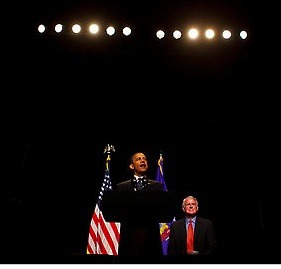
Here’s yet another example illustrating why one must treat the editorials at the Wall Street Journal as a primary source of hard news during Democratic presidential administrations. On Monday, President Obama visited ZBB Energy Corp, a maker of high-tech batteries in Menominee, Wisconsin. Helene Cooper at the New York Times , where a larger version of the picture at the right appeared, reported that “The company received a $1.3 million federal stimulus loan, which officials said would triple its manufacturing capacity and could lead to 80 new jobs.” Note the word “could.” At least the Times mentioned the existence of ZBB’s stimulus loan. In three brief reports mentioning the company during the past week, the Associated Press didn’t even do that. The WSJ’s intrepid editorialists did everyone else’s work for them and peeked behind the curtain at ZBB. It is not pretty: Uncle Sam, Venture Capitalist Meet the battery company that Obama visited yesterday. President Obama kicked off a five-state campaign swing yesterday with a stop at a “clean energy” plant in Menomonee Falls, Wisconsin. As it happens, Mr. Obama couldn’t have chosen a better company to demonstrate the risks that taxpayers are taking with their billions in green stimulus investment. … Mr. Obama praised it for “pointing the country toward a brighter economic future,” but we’ll let readers decide if they’d write the same checks if they were investing their own money. ZBB has been around for more than a decade, developing batteries and equipment to store energy from wind turbines and solar cells. … last January, when the Department of Energy announced $2.3 billion in “clean energy manufacturing tax credits,” ZBB was one of 183 recipients—collecting $14 million. We wonder who in government looked at ZBB’s filings with the Securities and Exchange Commission. Since going public in June of 2007, ZBB has been hemorrhaging money. The firm lost $4.9 million in fiscal 2008 and $5.5 million in fiscal 2009. In its most recent filing, in May, it said it had lost $6.9 million for the first nine months of its current fiscal year. It explained it had a “cumulative deficit” of $44.1 million and informed shareholders that it “anticipates incurring continuing losses.” It acknowledged that its ability to continue as a “going concern” was predicated on its ability to drum up additional funds. … Meanwhile, a review by the company’s audit committee last fall discovered that ZBB’s former CEO had been wrongly compensated as both an employee and an independent contractor, and that the company had failed to withhold his proper taxes. He stepped down, and the management team was reshuffled. ZBB was also forced to restate its financial results after a separate audit committee review found the company had recognized revenue from a contract in the wrong quarter. The company also acknowledged in its May filing that the 72,000 square foot manufacturing facility it bought in 2006 is “currently producing at less than 10% of its expected capacity.” That means it can’t currently access the $14 million in federal tax credits, which were supposed to help with equipment for a new facility. Meanwhile, private investors have soured on some energy-storage companies. ZBB’s initial public offering was priced at $6 a share in 2007, and it closed yesterday at 70 cents. A visit to the company’s quarterly income statements at NASDAQ.com reveals that sales during the four quarters that ended on March 31 were less than $2 million; the revenue line during the most recently reported quarter was a whopping $189,000. During that time, the company lost over $8 million. During the four years ended June 30, 2009 , ZBB burned through well over $20 million. You have to wonder how badly stimulus efforts such as these are going if a company in ZBB’s condition is considered worthy of a campaign stop. How bad are the situations at the ones that didn’t make the cut? The Journal gives a partial excuse to the White House press corps for not doing its work: “It has been dragged to so many of these energy events that it has lost interest in looking at the companies it visits.” Sorry, I’m not as forgiving. Allowing yourself to get scooped by a bunch of guys sitting in New York offices demonstrates how inexcusably lazy establishment press beat reporters following the president have become. That laziness would also appear to be influenced by the likelihood that if they really did their job, they’d have to report unpleasant things about their guy in the White House and the mostly accomplishment-free results of “clean energy” efforts thus far. You’ll know that they don’t even care about being scooped if, as I expect, the WSJ’s editorial is the first and last you’ll see of ZBB’s BS in the establishment press. Cross-posted at BizzyBlog.com .

More here:
ZBB BS: WSJ Editorial Scoops Beat Journalists on Financial Condition of Obama-Visited Company

Reporters Visiting WH for Off-the-Record Visit Work For Pubs That Demanded Transparency During Bush 43

File the news in this report filed late yesterday afternoon by Michael Calderone and John Cook at Yahoo’s Upshot Blog under “D” for Double Standards: White House reporters mum on Obama lunch, even as papers back transparency White House reporters are keeping quiet about an off-the-record lunch today with President Obama — even those at news organizations who’ve advocated in the past for the White House to release the names of visitors. But the identities of the lunch’s attendees won’t remain secret forever: Their names will eventually appear on the White House’s periodically updated public database of visitor logs. … The Obama White House began posting the logs in order to settle a lawsuit, begun under the Bush administration, from Citizens for Responsibility and Ethics in Washington (CREW), which sought the Secret Service’s White House visitor logs under the Freedom of Information Act. … And guess who filed briefs supporting that argument? Virtually every newspaper that covers the White House. The Washington Post filed an amicus brief in in February 2008 arguing that the names of White House visitors should be released, and it was joined by the Associated Press, Reuters, the Los Angeles Times, Wall Street Journal owner Dow Jones, USA Today, the Hearst Corporation, the New York Daily News, the Newspaper Guild, the Society of Professional Journalists, and a host of other news outlets. It’s unclear, of course, whether reporters for any of those newspapers attended the lunch — because none of them will say. Calderone found out anyway, and in a post early this afternoon , told us who was there: Ben Feller (Associated Press), Jonathan Weisman and Laura Meckler (Wall Street Journal), Michael Shear and Scott Wilson (Washington Post), Caren Bohan (Reuters), David Jackson (USA Today), Carol Lee (Politico), Peter Nicholas (Tribune Co.), Margaret Talev (McClatchy) and Julianna Goldman (Bloomberg). Several reporters on this list gave “no comments” to The Upshot on Thursday. The New York Times was invited but did not attend. White House reporter Peter Baker told The Upshot that the paper “politely declined because we’d like very much to talk on the record.” Readers here likely have memories of certain of the above reporters going out of their way to protect Barack Obama or to bash Bush 43. The appearance of Weisman’s name reminded me of an absolutely pathetic massage job he did when he was at the Washington Post . In August 2005, as seen here , Weisman turned what had been an upbeat item about July’s unemployment report by another Post reporter (“Job Growth Strongest in 3 Months”) into a co-written hit piece on Bush (“Economic News Isn’t Helping Bush; Job Growth Up Sharply in July, but Polls Show Dissatisfaction”). Here were most of the report’s three opening paragraphs: U.S. job growth jumped last month and the unemployment rate held steady … the government reported yesterday, the latest economic data to show the economy picking up steam. Yet President Bush’s economic approval ratings remain low, weighed down by anger over Iraq and concerns about lackluster wage increases and stubbornly high gasoline prices. “I feel the economy is just not as good as it should be,” said Adam Judis, 40, a Pasadena, Calif., computer consultant and political independent. “We’re spending too many lives, resources and money on Iraq. There has to be a point where we say we can’t help everybody. We need to help ourselves.” My reax at the time : The Post feels it’s their duty to massage the news for their print subscribers. They just couldn’t let the story go to print without throwing cold water on it, so they found one guy to change the subject to Iraq, and then presented poll results to “prove” that Bush really isn’t handling the economy well (even though the objective evidence says his administration is). This is a clearly conscious, obvious, and disgraceful effort to turn good news into bad news. You may be wondering what the economic news was that left Weisman unimpressed because of Iraq, gas prices, and supposedly flat wages: In July 2005 , the economy added 207,000 jobs, and the unemployment rate was 5%. Yeah, that bad (/sarc). Watch what Weisman writes at the WSJ warily. It probably wouldn’t be a bad idea to keep an special eye on each of the lunch’s attendees for the next few months. One other thought: Things are pretty bad in journalism when the security-leak sieve known as the New York Times leads the way in ethics by choosing not to participate in the off-the-record luncheon. Cross-posted at BizzyBlog.com .

Read more here:
Reporters Visiting WH for Off-the-Record Visit Work For Pubs That Demanded Transparency During Bush 43